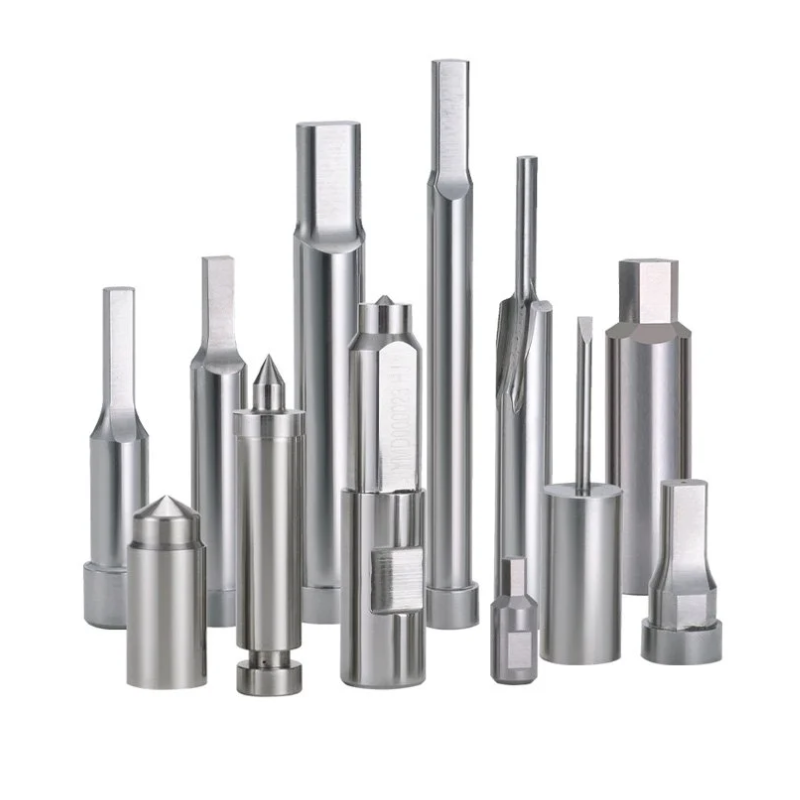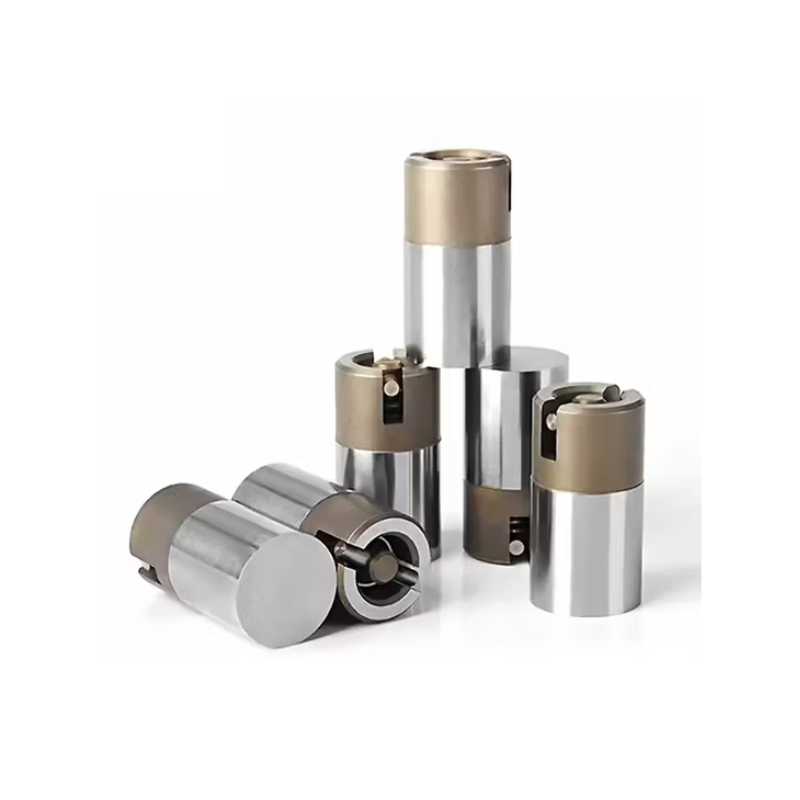
Tablet punch specifications are defined by the tooling standard, tablet press configuration, punch geometry, and required tablet design. Key specifications include punch barrel diameter, working length, overall length, head configuration, tip diameter, cup depth, and punch face profile. Common tooling configurations include B, D, BB, and DB, while TSM and EU standards define different dimensional and head configurations for tablet presses.
For custom tablet punches, the required press model, tooling standard, existing punch dimensions or drawing, tablet shape, and critical tolerances should be confirmed before manufacturing.
What Are Tablet Punch Specifications?
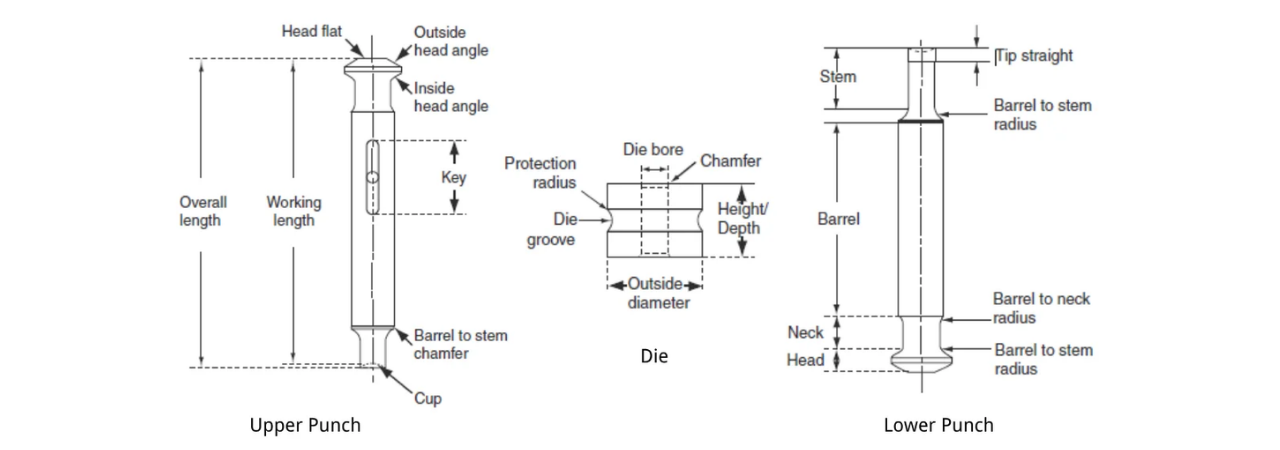
Tablet punch specifications describe the complete set of dimensions, tolerances, and design features that determine whether a punch will fit a specific tablet press and produce a tablet of consistent weight, thickness, and hardness.
A specification is not just a diameter. It is a combination of tooling standard, tooling type, and critical dimensions that must all match the press and the tablet design.
| Specification | What It Defines |
|---|---|
| Tooling Standard | TSM, EU, or other configuration |
| Tooling Type | B, D, BB, DB |
| Barrel Diameter | Punch body size |
| Working Length | Critical length within a punch set |
| Overall Length | Total punch length |
| Head Configuration | Punch interaction with the press |
| Tip Diameter | Tablet-forming area |
| Cup Depth | Punch face depth |
| Face Profile | Tablet surface geometry |
| Material | Tool steel, stainless steel, carbide, etc. |
| Surface Treatment | Polishing, coating, or other treatment |
The working length is the most critical dimension in this list. It is the distance from the head flat to the lowest point of the cup, and it directly determines tablet weight, thickness, and hardness. Variation within a punch set should be tightly controlled—typically within ±0.002 inch TIR (total indicator runout) according to TSM specifications.
This is different from overall length, which is the total physical length of the punch. Cup depth contributes to overall length, but it is not the dimension that controls tablet weight. Working length is.
Tablet Punch Specifications by Tooling Type
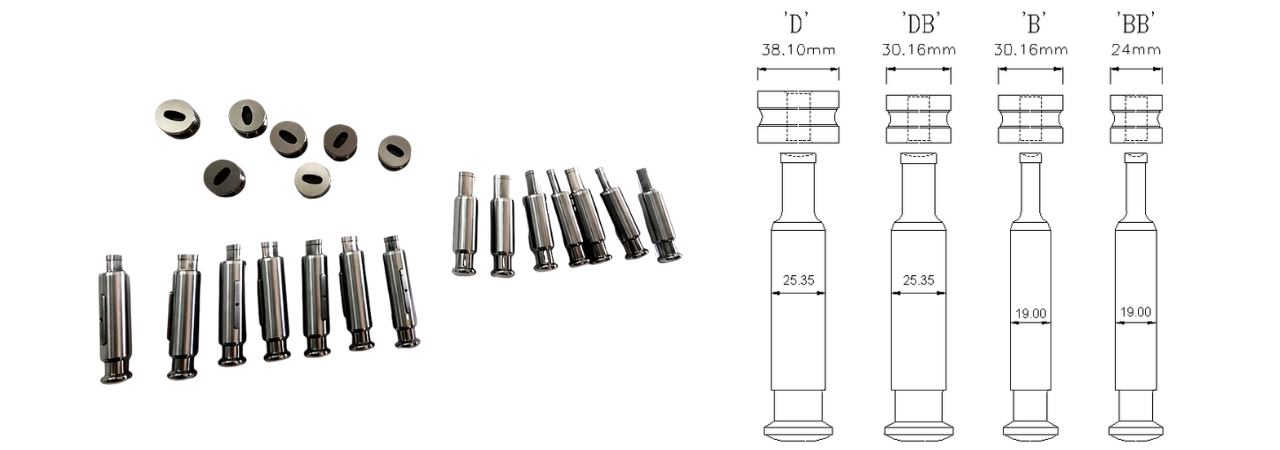
The four standard tooling configurations are defined by the punch barrel diameter and the die outer diameter.
| Tooling Type | Punch Barrel Diameter | Typical Die OD | Typical Application |
|---|---|---|---|
| B | 19.00 mm | 30.16 mm | Medium-size tablets and high-output applications |
| D | 25.35 mm | 38.10 mm | Larger tablets and higher compression requirements |
| BB | 19.00 mm | 24.00 mm | Smaller tablets / higher station density |
| DB | 25.35 mm | 30.16 mm | D-size punch barrel with B-size die OD |
Note: Dimensions and tablet-size capabilities can vary by tooling standard, press configuration, and design. The values above are typical reference dimensions rather than a universal specification for every tablet press.
B Tooling
B tooling uses a 19.00 mm punch barrel with a 30.16 mm die outer diameter. It is the most common configuration for medium-size tablets and high-output rotary tableting. The smaller punch body allows a higher number of stations in suitable turret configurations, which increases output per revolution.
D Tooling
D tooling uses a 25.35 mm punch barrel with a 38.10 mm die outer diameter. The larger body supports larger tablets and higher compression forces. It is typically used where tablet size or compression requirements exceed what B tooling can handle.
BB Tooling
BB tooling also uses a 19.00 mm punch barrel, like B tooling, but pairs it with a smaller 24.00 mm die outer diameter. This configuration is used for smaller tablets where higher station density is needed, or where the die space is limited.
DB Tooling
DB tooling combines a D-size punch barrel (25.35 mm) with a B-size die outer diameter (30.16 mm). This hybrid configuration is used when the punch body needs the larger D-size support, but the die must fit a smaller space.
For press-specific tooling configurations, see our custom dies and punches for tableting.
TSM vs EU Tablet Punch Specifications
TSM and EU are the two dominant tablet tooling standards. They are similar in overall concept but differ in head geometry, head thickness, and overall length.
| Feature | TSM | EU |
|---|---|---|
| Standard | Tableting Specification Manual (US) | Euronorm (Europe) |
| Typical market | Primarily US / Americas | Common internationally, especially Europe |
| Head profile | Angled top profile | Domed head profile |
| B punch inside head angle | 37° | 30° |
| Overall punch length | TSM is 0.010 inch shorter than EU (B/D comparison) | Reference EU configuration |
| Interchangeability | Cannot be assumed interchangeable | Cannot be assumed interchangeable |
Are TSM and EU tablet punches interchangeable?
No. TSM and EU tooling should not be assumed to be interchangeable. Although the two standards are similar, differences in head configuration, head thickness, and overall length require the press and tooling standard to be verified before replacement or ordering.
The most common mistake is ordering a replacement punch by dimensions alone without confirming the standard. A punch that looks dimensionally close may not seat correctly in the press, and the head angle difference alone can affect compression behavior.
Key Tablet Punch Dimensions
Barrel Diameter
The barrel diameter is the outer diameter of the punch body. It must match the turret bore in the tablet press. If the barrel diameter is wrong, the punch will not fit or will not be retained properly.
Working Length
Working length is the distance from the head flat to the lowest point of the cup. It is the single most important punch dimension for tablet quality. Variation in working length within a punch set causes tablet weight, thickness, and hardness variation. The TSM standard specifies a working length tolerance of 0.002 inch TIR within a set of upper or lower punches.
Overall Length
Overall length is the total physical length of the punch. It is not the same as working length. Overall length is used for handling, storage, and press setup, but it does not directly control tablet weight. Do not use overall length as a substitute for working length when specifying replacement punches.
Head Configuration
The head is the part of the punch that interacts with the press cams. TSM heads have an angled top profile with a 37° inside head angle for B tooling. EU heads have a domed profile with a 30° inside head angle. Head thickness also differs between the two standards. These differences affect how the punch sits in the turret and how the compression force is applied.
Tip Diameter
The tip diameter is the tablet-forming area. It must match the required tablet diameter, accounting for any bevel or radius on the tablet edge.
Cup Depth
Cup depth is the depth of the concave area on the punch face. It is integral to overall punch length, but it is not the critical dimension for tablet weight. Working length is more important. Cup depth does have its own tolerance—most tablet press punches have a cup-depth tolerance of ±0.003 inch—but working length tolerance is tighter and more critical.
Face Profile
Face profile defines the tablet surface geometry. Common profiles include:
Flat Face
Flat Face Bevel
Shallow Concave
Standard Concave
Deep Concave
Modified Ball
The profile must match the tablet design, including any embossing, logo, or score line. For custom face profiles, send a drawing or sample for review.
Tablet Punch Materials, Hardness & Surface Finish
Material selection for tablet punches depends on the formulation being compressed, production volume, sticking or picking risk, and required tool life. Common options include tool steels, stainless steels, and carbide for abrasive or high-volume applications.
Required hardness depends on the selected tool steel, tooling design, and application. There is no single hardness value that applies to every tablet punch. A harder punch resists wear but may be more sensitive to impact. A softer punch is more forgiving but wears faster.
Surface finish requirements depend on the tablet formulation, sticking and picking risk, polishing requirements, and tooling design. A smoother surface reduces friction and material adherence, but the required finish level is application-specific. For formulations with high sticking tendency, a highly polished surface or a specific coating may be needed.
HTX Precision manufactures custom dies and punches for tableting in a range of materials and surface finishes. For application-specific material recommendations, send us your tablet formulation and production conditions.
How Does Tablet Press Compatibility Affect Punch Specifications?
Tablet punch specifications cannot be selected independently from the tablet press. The press model, turret configuration, tooling standard, punch dimensions, and die dimensions must all be matched before manufacturing or replacement.
The following information is required to confirm compatibility:
Press manufacturer and model
Turret configuration
Tooling standard (TSM, EU, or other)
Tooling type (B, D, BB, DB)
Existing punch dimensions
Existing die dimensions
Drawing or sample of the existing tooling
If you are replacing tooling on an existing press, the safest approach is to provide the existing punch or a drawing. Dimensions alone are not always sufficient, especially when the tooling standard is uncertain or the press has been modified.
Need tooling matched to a specific tablet press? See our custom tablet tooling solutions.
What Specifications Are Needed for Custom Tablet Punches?
Before requesting a quote for custom tablet punches, prepare the following information.
Basic information:
Tablet press model and manufacturer
Tooling standard (TSM / EU / other)
Tooling type (B / D / BB / DB)
Upper or lower punch
Dimensional information:
Barrel diameter
Working length
Overall length
Head dimensions
Tip diameter
Cup depth
Face profile
Tablet design:
Tablet diameter
Tablet thickness
Shape
Embossing
Logo / lettering
Score line
Material and performance:
Material
Heat treatment
Surface finish
Coating
Production volume
Reference:
Drawing
Existing punch
Sample
Photos with dimensions
If you do not have a complete specification, HTX Precision can review an existing punch, drawing, or sample to help confirm the required tooling dimensions before production.
How to Choose the Correct Tablet Punch Specifications
Step 1: Identify the tablet press.
Confirm the press manufacturer and model, and the turret configuration.
Step 2: Confirm the tooling standard.
TSM, EU, or another standard. Do not assume they are interchangeable.
Step 3: Confirm the tooling type.
B, D, BB, or DB. This determines the punch barrel diameter and die outer diameter.
Step 4: Confirm the tablet dimensions and shape.
Tablet diameter, thickness, face profile, embossing, and any score line.
Step 5: Confirm critical punch dimensions.
Working length is the most critical. Overall length, head configuration, tip diameter, and cup depth must also be verified.
Step 6: Select material and surface finish.
Based on the formulation, production volume, and sticking/picking risk.
Step 7: Verify drawing or sample.
If replacing existing tooling, compare against the original drawing or a physical sample.
Step 8: Manufacture and inspect.
Confirm all critical dimensions before production, and inspect the finished punches against the approved specification.
FAQ
What are the standard specifications of tablet punches?
Standard tablet punch specifications include tooling standard (TSM or EU), tooling type (B, D, BB, DB), barrel diameter, working length, overall length, head configuration, tip diameter, cup depth, and face profile. Material, hardness, and surface finish are also part of the complete specification.
What is the difference between B, D, BB, and DB tablet tooling?
B tooling uses a 19.00 mm punch barrel and 30.16 mm die OD. D tooling uses a 25.35 mm punch barrel and 38.10 mm die OD. BB tooling uses a 19.00 mm punch barrel with a smaller 24.00 mm die OD. DB tooling combines a D-size punch barrel with a B-size die OD.
What is the difference between TSM and EU tablet punches?
TSM and EU punches differ in head geometry, head thickness, and overall length. TSM B tooling has a 37° inside head angle; EU B tooling has a 30° angle. The TSM punch is approximately 0.010 inch shorter than the EU equivalent in B/D comparisons. They cannot be assumed interchangeable.
What is working length on a tablet punch?
Working length is the distance from the head flat to the lowest point of the cup. It is the most critical punch dimension because it directly controls tablet weight, thickness, and hardness. Variation within a punch set should be tightly controlled.
What is cup depth on a tablet punch?
Cup depth is the depth of the concave area on the punch face. It contributes to overall punch length but is not the critical dimension for tablet weight. Working length is more important for tablet quality control.
How do I choose the correct tablet punch size?
Start with the tablet press model and tooling standard, then confirm the tooling type (B, D, BB, or DB). Match the tip diameter to the tablet size and the working length to the press specification. Verify material and surface finish based on the formulation.
Are TSM and EU tablet punches interchangeable?
No. TSM and EU tooling are similar in concept but differ in head configuration and dimensions. They should not be assumed interchangeable. The press and tooling standard must be verified before ordering.
What information is needed to manufacture custom tablet punches?
Provide the press model, tooling standard, tooling type, existing punch dimensions or drawing, tablet design details, required material and surface finish, and production volume. A drawing or sample is preferred when available.
Get Help with Tablet Punch Specifications
If you are unsure which tooling standard or configuration you need, send us your press details, existing punch dimensions, or a drawing. HTX Precision manufactures custom dies and punches for tableting to TSM, EU, and other specifications.
Request a custom tablet punch quote, and we will review your requirements before production.