
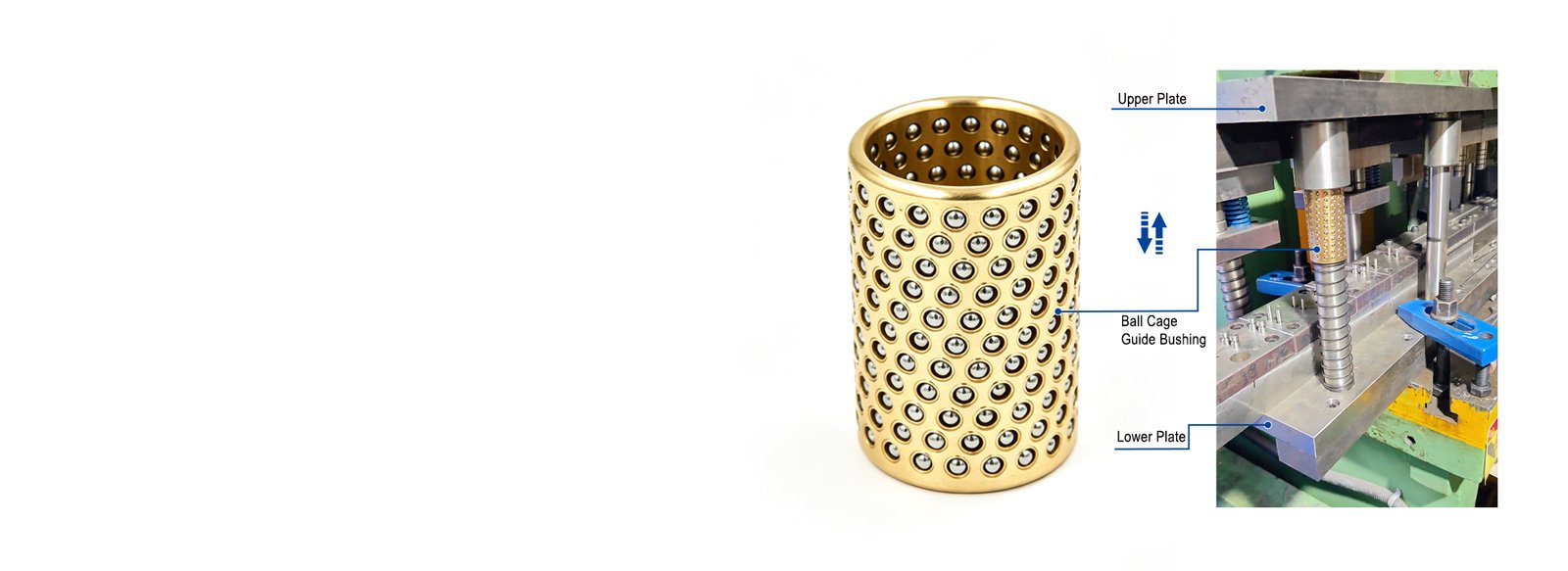
What Is a Brass Ball Cage?
A brass ball cage is a precision mold guide component consisting of a brass cage body and hardened bearing steel balls.
The brass cage structure provides excellent wear resistance, dimensional stability, and long-term reliability under repeated mold movements. It is commonly used in stamping dies, injection molds, and precision tooling systems where stable alignment and extended service life are required.
Compared with plastic or aluminum ball cages, brass ball cages provide higher mechanical strength and better durability under repeated mold movements.
Why Choose Brass for Your Ball Cages?

For High-cycle injection molds and stamping die applications, brass ball cages can reduce wear between the guide components, ensure stable performance during continuous production, and provide a longer service life for the mold. They can provide excellent wear resistance under repeated mechanical movements.

The brass ball cages hold their structural integrity under continuous, cyclic loading. It keeps the guide motion consistent, even in medium to high load applications like industrial tooling and precision guide systems.

The brass can hold its shape under repeated mechanical cycling. It keeps the steel ball in the right position; consistent positioning and precision are maintained throughout every operating cycle, effectively minimizing the impact of misalignment on the mold.

Brass is inherently easy to machine, allowing for the production of high-precision, complex cages without the need for specialized cutting tools. Its material properties make it a top choice for OEM requirements, specialized designs, and custom manufacturing based on provided drawings; it is equally well-suited for small-batch production.

The brass ball cage maintains stable performance under moderate temperature conditions. Brass maintains stable mechanical properties in normal mold operating environments. In injection molds and various industrial applications, it does not soften or deform, ensuring stable guidance without performance degradation due to heat.
Engineering Design Features of HTX Brass Ball Cage
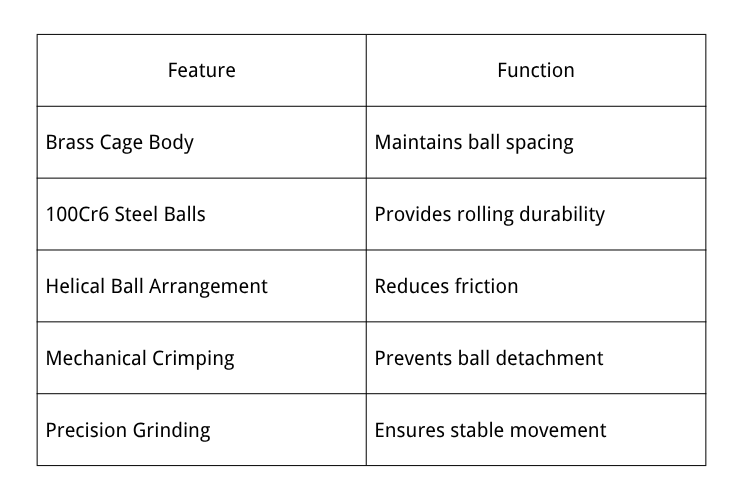
- The brass cage body maintains the ball spacing and carries the guide assembly load.
- High hardness, wear resistance, and hardened 100Cr6 for the bearing steel body.
- The balls are arranged in an orderly manner, preventing friction between them.
- Each steel ball is secured via a mechanical crimping process to prevent detachment during transport, installation, and operation, while also ensuring stable performance.
- Strictly control the inner diameter, spacing, and surface finish of the ball cage within controlled tolerances to ensure consistent rolling resistance.
Standard Brass Ball Cage Models
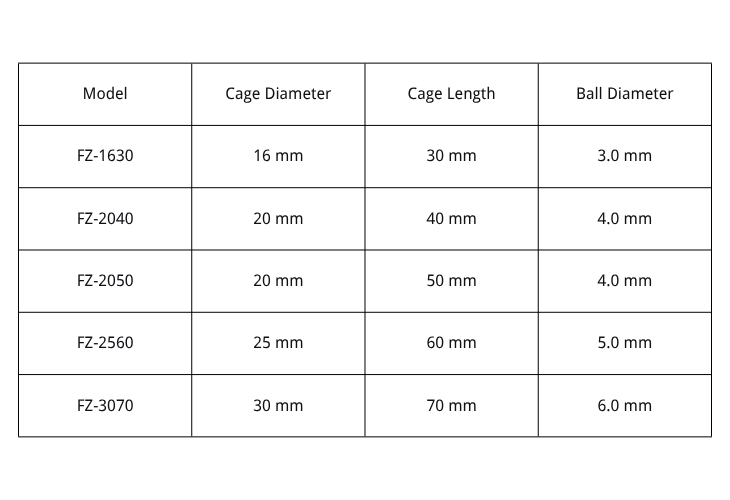
Standard brass ball cages follow a clear naming system, allowing key dimensions to be quickly identified from the model number.
Take FZ-1630 as an example. The number breaks down into two parts:
16 = Cage diameter in millimeters
30 = Cage length in millimeters
The prefix “FZ” identifies the product series. Once you know this format, you can read the core dimensions of any standard model at a glance.
The date is only for reference. Confirm the actual specifications with our sales team.
Custom Brass Ball Cage Manufacturing
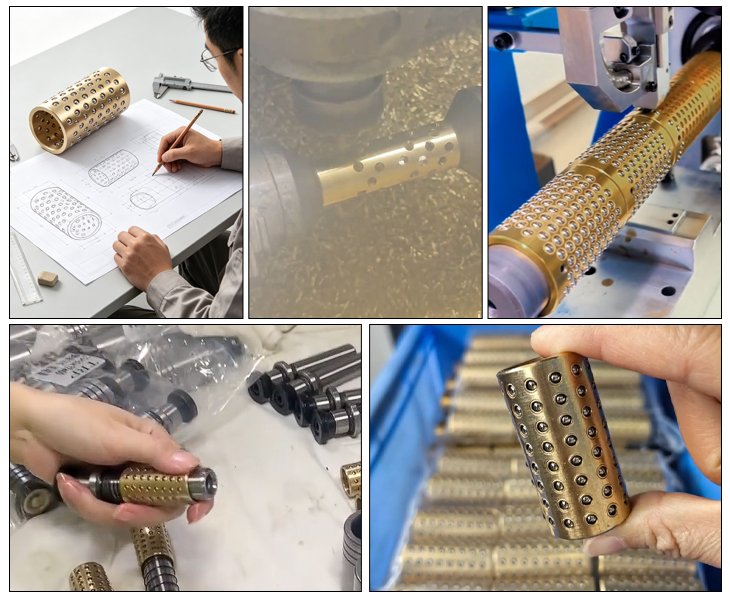
Your drawing defines the cage; HTX handles the full chain, from review, machining, assembly, to inspection; you just need to install it for use.
- Drawing Review: The dimensions, movement requirements, and application conditions need to be confirmed before cutting.
- Material Confirmation: Brass grade, ball material, and hardness spec are locked against your drawing.
- Precision Machining: The ball pockets and the cage profile should be machined in one setup to maintain accuracy.
- Steel Ball Assembly: Load the steel balls and secure them mechanically, ensuring that each ball is fixed in its designated position while remaining free to rotate.
- Final Inspection: All critical dimensions are inspected before shipment, including dimensional inspection, ball pocket accuracy inspection, inner and outer diameters, ball spacing, tolerance, and running smooth inspection.
When Another Material May Be More Suitable
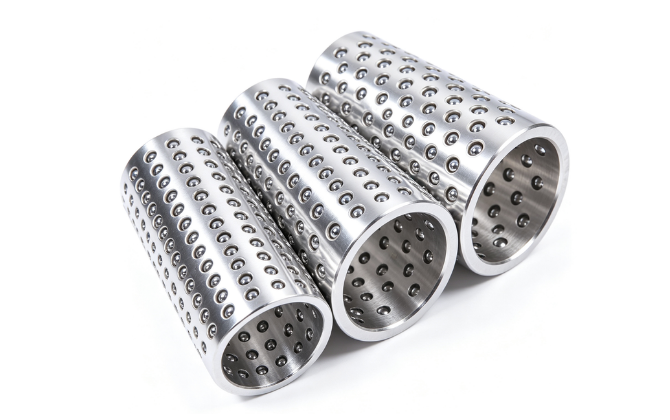
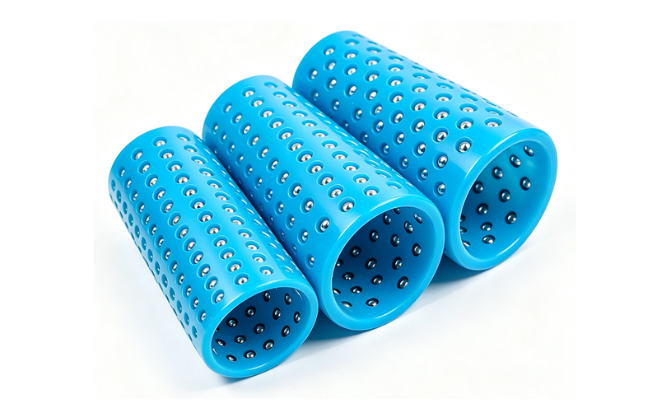
The suitable material selection depends on the operating conditions.
For the aluminum ball cage, it is more suitable for high-speed applications, but it cannot bear very heavy loads.
But for lightweight applications and lower load conditions, the plastic ball cage is more suitable.
When Should You Choose a Brass Ball Cage?
The recommended applications for the brass ball cages are:
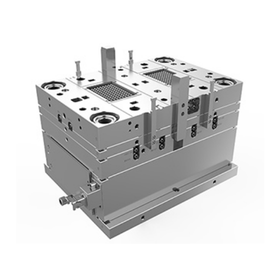
In mold applications involving millions of cycles and spanning the medium-to-high range, brass ball cage guidance systems demonstrate excellent stability, wear resistance, and precision; under identical operating conditions, they offer a longer service life than sliding guide bushings.
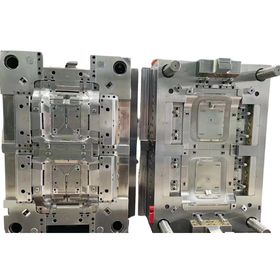
In applications requiring a balance between low friction and positioning accuracy, a brass ball cage ensures reliable alignment, while the uniform rolling element design effectively prevents stick-slip.
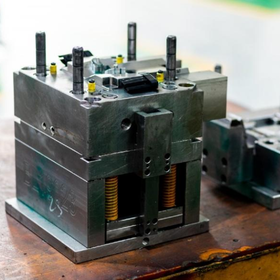
Long service life, continuous clamping pressure, and thermal expansion pose the greatest challenges to the guiding system. Brass ball cages provide stable mold alignment and reduce wear during long-term production operation, preventing flash and displacement.
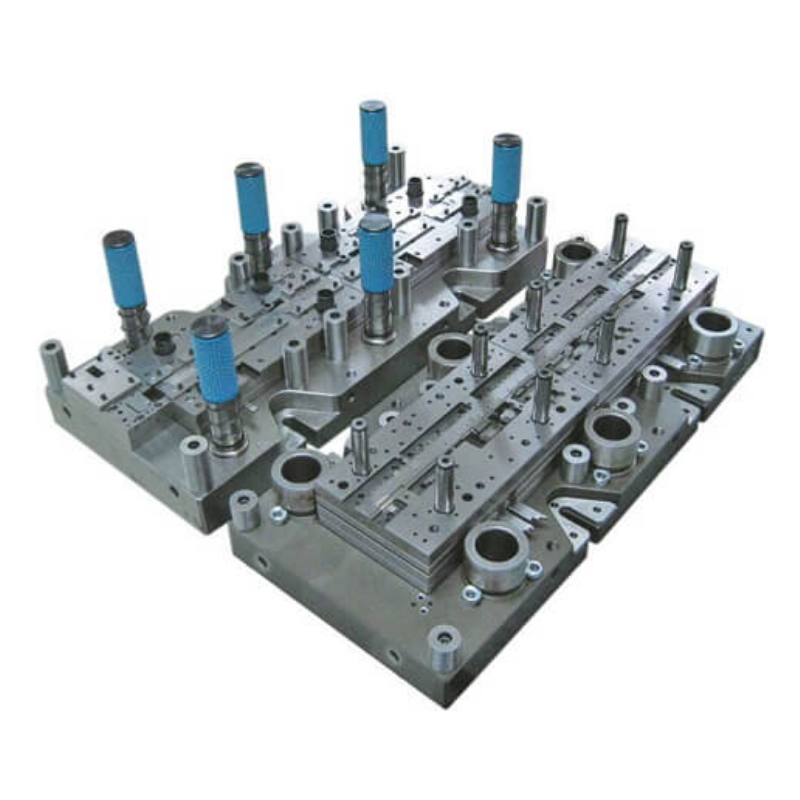
The guiding system of a stamping die must withstand high-intensity loads during repeated impacts; brass offers superior strength and toughness compared to plastic, while also ensuring consistent alignment accuracy with every stroke.
Brass Ball Cage vs Plastic & Aluminum Ball Cage
| Performance | Brass | Aluminum | Plastic |
| Wear Resistance | Excellent | Good | Medium |
| Mechanical Strength | High | Medium | Low |
| Weight | Medium | Light | Very Light |
| High Cycle Performance | Excellent | Good | Application Dependent |
| Load Capacity | Medium-High | Medium | Low |
| Temperature Resistance | Up to 150°C | Medium | Lower |
| Machining Capability | Excellent | Excellent | Limited |
| Typical Application | Precision molds | High-speed molds | Light-duty applications |
It is widely used for stamping dies, injection mold, and precision guide systems.
The brass cage has higher mechanical strength and better wear resistance.
Yes, contact us for a free quotation.
We use 100Cr6 for the steel balls.
The service life depends on the following:
- Load
- Speed
- Lubrication
- Operating environment
- Installation accuracy
The helical arrangement allows each ball to run in its own path, reducing friction and improving smooth movement.
Brass Ball Cage Selection Guide
| Requirement | Recommended |
| High cycle production | Brass |
| Precision alignment | Brass |
| Heavy impact stamping | Brass |
| High speed lightweight | Aluminum |
| Low noise operation | Plastic |