
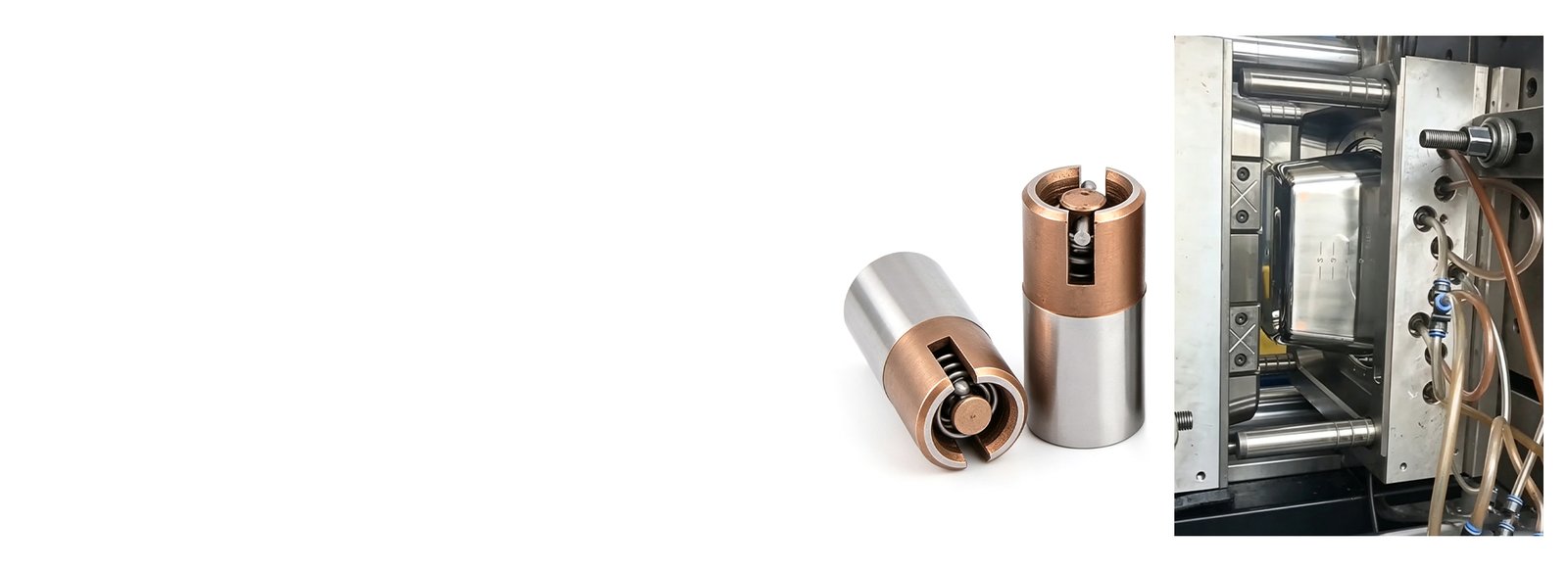
What Is an Injection Mold Air Poppet Valve?
An air poppet valve is a spring-loaded mold component installed inside a plastic injection mold to release residual air during the ejection process and prevent vacuum formation.
During the injection molding process, certain plastic products may experience a vacuum effect on the surfaces of molded parts and cavities, particularly in deep cavities, thin-walled products, or products with a large contact area. The air poppet valve provides a controlled air release path, allowing air to enter the cavity during the ejection process and facilitating the smooth separation of the part from the mold surface.
Unlike traditional ejector pins, the air poppet valve addresses demolding issues by controlling air release rather than through mechanical thrust.
Technical Specifications of JMT-A1 Air Poppet Valve
| Parameter | Specification |
| Product Type | Injection Mold Air Poppet Valve |
| Model | JMT-A1 |
| Type | TW |
| Material | SUS420 Stainless Steel |
| Hardness | 48-52 HRC |
| Structure | Spring-loaded Piston Type |
| Function | Vacuum Release During Ejection |
| Working Temperature | Approx. 220°C |
| Application | Plastic Injection Mold |
| Customization | Drawing Based |
How does the Air Poppet Valve work
JMT-A1 air poppet valve features a spring-loaded piston design that regulates airflow during mold operation.
Molten plastic fills the mold cavity under injection pressure, while the air poppet valve remains closed to prevent plastic from entering the valve structure.
Once the plastic has finished being injected, a vacuum may form between the plastic product and the mold cavity surface when the mold opens.
During the ejection process, the piston is mechanically activated, opening the air passage and allowing air to enter through the vent hole.

Air enters the cavity, eliminating the vacuum effect and reducing the adhesive force, allowing the product to be easily removed from the mold.
Advantages of JMT-A1 Air Poppet Valves

Precision-engineered for drop-in assembly with minimal fitting work.

Fits into compact mold structures where standard ejector pins are difficult to position.

Reduces vacuum suction during ejection, improving demolding stability for difficult-to-release parts.

Operates reliably in injection molding environments up to 220°C.
Material & Structure of HTX Injection Mold Air Poppet Valve
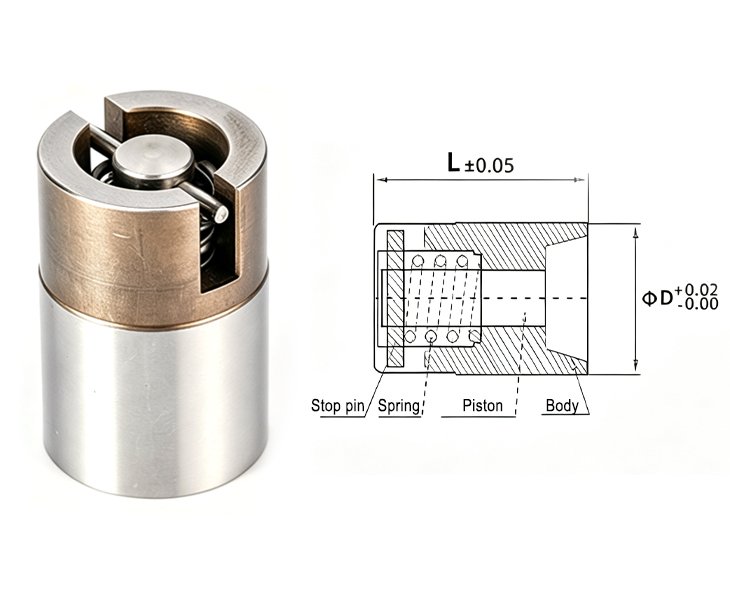
The JMT-A1 Air Poppet Valve features precision-machined components designed for stable operation within injection molds.
- The internal insert utilizes a spring-pin retention design.
- This prevents the locating pin or insert from detaching during valve operation.
- It ensures long-term, stable performance throughout repeated molding cycles.
| Component | Material | Function |
| Valve Body | SUS420 Stainless Steel | Provides wear resistance and stable installation |
| Piston | Hardened Steel | Controls air release movement |
| Spring | Spring Steel | Returns the piston after air release |
| Stop Pin | Steel | Controls piston movement and prevents excessive travel |
| Vent Hole | Precision Machined | Allows controlled air flow |
| Soft Pad | Elastic Material | Protects contact area during operation |
Manufacturing Process for The Poppet Valve
- SUS420 Stainless Steel Valve Body
HTX manufactures the air poppet valve from wear-resistant and corrosion-resistant SUS420 stainless steel, ensuring robust stability during operation.
- Precision Machining
Each internal component undergoes precision machining, grinding, and dimensional inspection to ensure precise assembly among the piston, spring, and valve body.
- Quality Control
Each air poppet valve must undergo dimensional inspection, surface quality checks, and functional assembly testing before shipment to ensure it is ready for immediate assembly and use upon arrival at the customer’s facility.
How To Choose an Air Poppet Valve?
- Confirm the Installation Space
Measure the outer diameter and depth of the module or insert where the air poppet valve is to be installed; ensure the valve fits without interfering with cooling channels or cavity edges, and select the appropriate model based on these dimensions.
- Standard or custom size
If the installation dimensions match our standards, you can place an order directly with us. If they do not match perfectly, you can send us drawings for a custom solution or contact us for professional recommendations.
With 24+ years of precision manufacturing experience, HTX supports OEM and ODM projects from drawing to finished component.
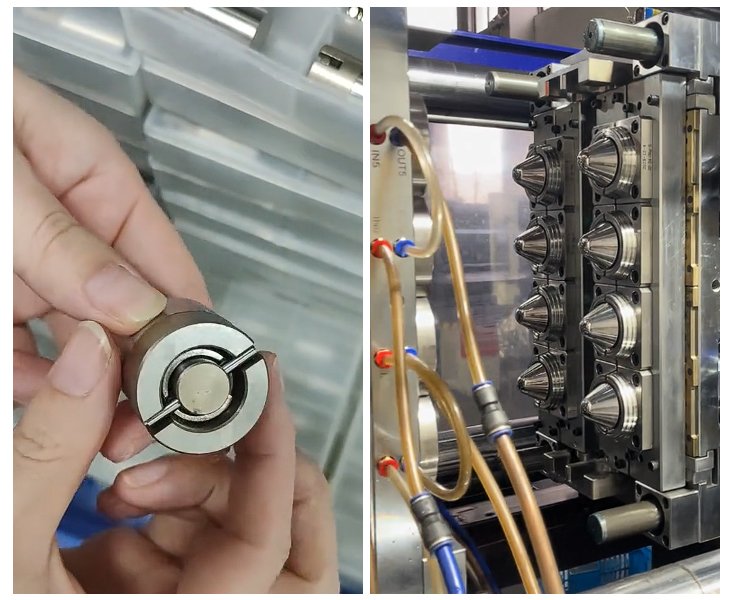
Injection Mold Application of the Air Poppet Valve
Air poppet valves address the challenge of vacuum-assisted demolding across various applications by controlling air release, though the specific requirements for each application differ slightly.
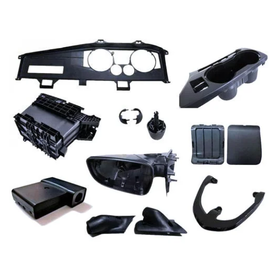
Automotive interior and exterior trim components often feature deep ribs or large contact surface areas—geometries prone to creating a vacuum effect. Air poppet valves may help improve production efficiency by reducing demolding issues.
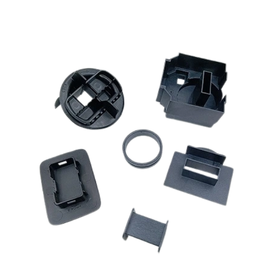
Connectors, housings, and precision covers in the electronics industry are subject to strict requirements regarding surface quality and dimensional tolerances; such thin-walled designs are particularly prone to sticking and deformation. Compact air poppet valves easily resolve these issues, effectively preventing surface defects.
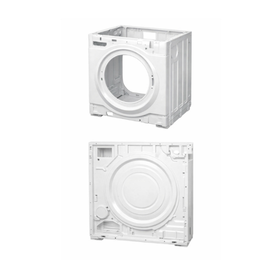
In the home appliance industry, components such as panels, trays, and deep-cavity parts are prone to generating a strong vacuum during mold opening; this is where air poppet valves prove their value. They introduce airflow into the cavity to balance internal pressure, enabling smooth demolding—a task that standard ejector pins alone cannot accomplish under these operating conditions.
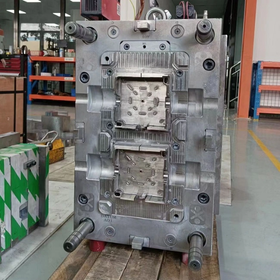
Thin-wall molding, complex cavity structures, and high-cycle production molds all require rapid ejection. Air poppet valves support the demands of industrial applications for speed and long mold service life.
Standard and Optional Sizes
The JMT-A1 air poppet valve is available in multiple diameters and lengths to fit different injection mold structures.
★ Standard Size
The solid star mark (★) represents standard sizes that are available for direct ordering and regular production.
☆ Optional Size
The hollow star mark (☆) represents optional sizes available according to customer requirements.
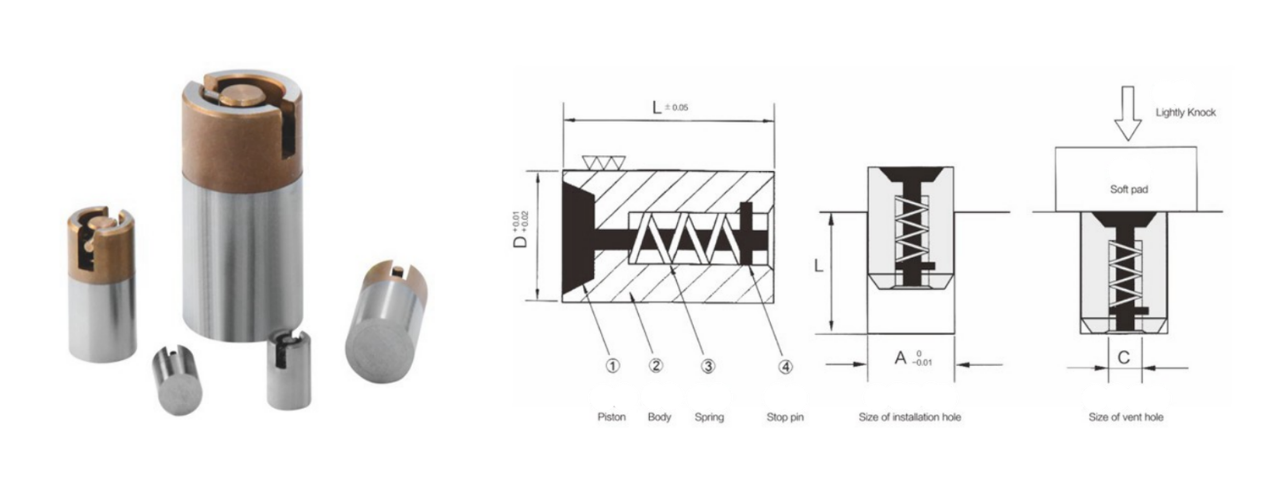
| Order Number | Type | D (External Diameter) | Available Length L | A | C |
| JMT-A1 | TW | 5 | / ★12 / | 5 | 4 |
| JMT-A1 | TW | 6 | / ★12 / | 6 | 4.2 |
| JMT-A1 | TW | 8 | / ☆12 / ★15 / | 8 | 4.5 |
| JMT-A1 | TW | 10 | / ☆12 / ☆15 / ★20 / | 10 | 7 |
| JMT-A1 | TW | 12 | / ☆12 / ☆15 / ☆20 / ★25 | 12 | 7.7 |
| JMT-A1 | TW | 16 | / ★30 / | 16 | 10.3 |
| JMT-A1 | TW | 18 | / ★35 / | 18 | 12 |
| JMT-A1 | TW | 20 | / ☆30 / ★35 / | 20 | 12.9 |
| JMT-A1 | TW | 25 | / ☆30 / ★45 / | 25 | 14.9 |
| JMT-A1 | TW | 30 | / ☆30 / ★45 / | 30 | 18 |
Yes, the valve must be installed with its air vent facing the mold cavity. Installing it the wrong way around will block the airflow path, rendering the vacuum release function ineffective.
No; the internal piston of the air poppet valve remains closed under injection pressure, and the internal clearance is too tight for most molten plastics to penetrate.
It depends on the cavity area and the severity of the vacuum; for molds with large surface areas or deep cavities, multiple valves should be positioned in the problematic zones. Additional valves can be added in specific areas prone to sticking.
Minimal. The internal spring and piston form a self-contained unit, requiring no additional maintenance. You only need to periodically check the vent for blockages; if the valve stops releasing air, simply check the piston area for contaminants.
Yes, an ejector pin provides mechanical thrust, while an air poppet valve releases the vacuum suction. The combined use of these two is particularly common in applications involving flat surfaces or thin-walled parts.
A mold vent removes gas generated during injection filling, while an air poppet valve releases vacuum pressure during ejection. They solve different molding problems.
Air Poppet Valve vs Ejector Pin: Differences in Injection Mold Applications
| Air Poppet Valve | Traditional Ejector Pin | |
| Main Function | Vacuum release | Mechanical pushing |
| Vacuum Problem Solution | Excellent | Limited |
| Installation Space | Compact | Requires ejector system space |
| Suitable Application | Deep cavity / difficult demolding | General ejection |
Want to know more about air poppet valve vs ejector pin? Click to read more→