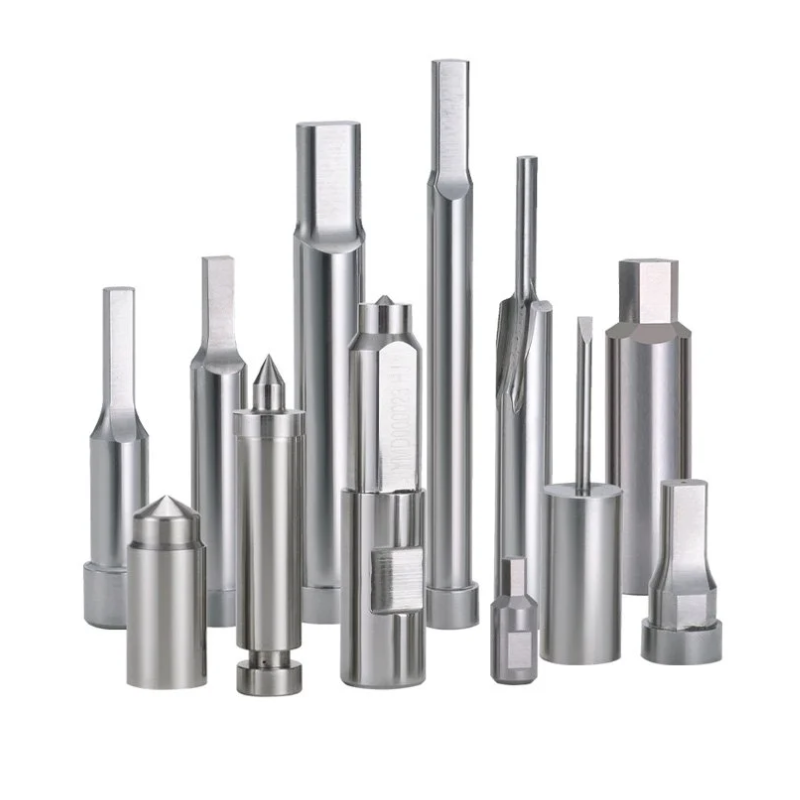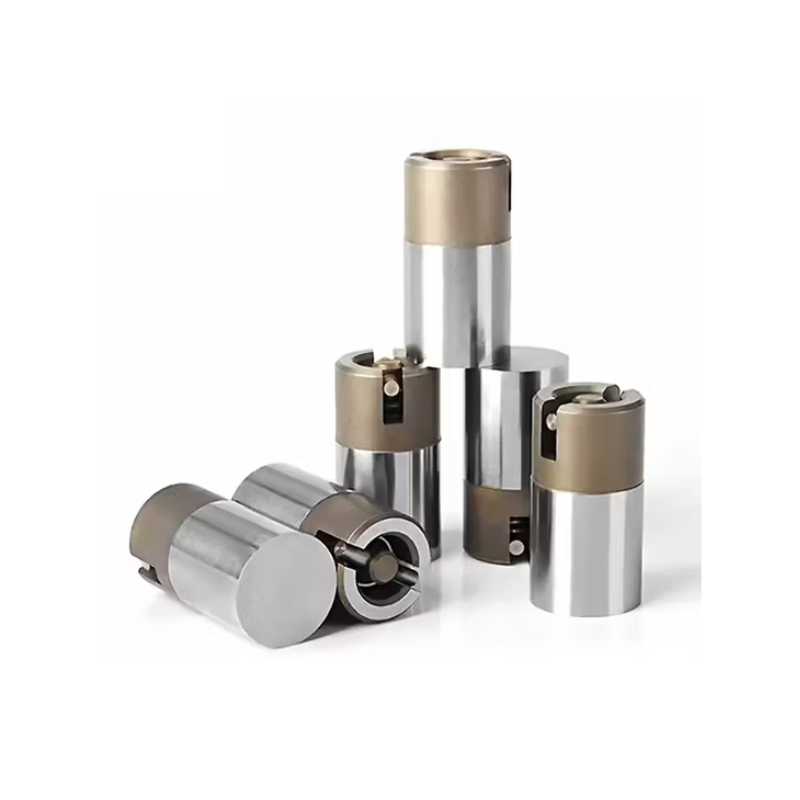
If you design or maintain injection molds, you need to know the main ejector pin types and when each one works best. This page provides a clear selection guide to help you match the right pin type to your part geometry and ejection requirements.
Quick Answer: Straight ejector pins are the default choice for most molds. Use blade ejector pins for narrow ribs or slots. Use step ejector pins when the ejection point is small, but you need a larger support shaft behind it. Use shoulder ejector pins when you need a built-in stop or additional guidance. Use square ejector pins to prevent rotation. Use nitrided ejector pins for higher wear resistance in abrasive or high-cycle applications.
Ejector Pin Type Overview
| Type | Main Feature | Typical Application |
| Straight Ejector Pin | General-purpose round pin | Standard ejection from flat or solid areas |
| Step Ejector Pin | Stepped geometry with small tip and larger shaft | Complex ejection, small contact area with extra support |
| Shoulder Ejector Pin | Larger diameter shoulder along the body | Guided ejection, stroke stop, or specific fit requirements |
| Blade Ejector Pin | Thin blade geometry | Narrow ribs, thin slots, and restricted spaces |
| Square Ejector Pin | Non-round square or rectangular section | Prevent rotation or match non-round holes |
| Nitrided Ejector Pin | Surface treatment on round or stepped pins | Higher wear resistance, abrasive resins, long runs |
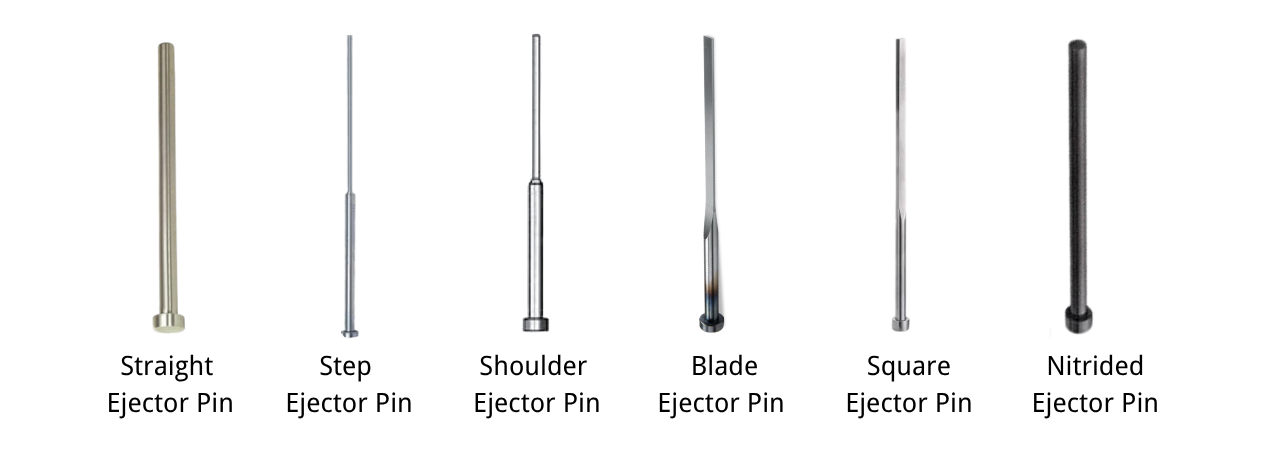
Straight Ejector Pin
Straight ejector pins are the default choice for most injection molds. They have a uniform round diameter along the working length and are simple to machine, fit, and replace.
Use a straight pin when the ejection area is large enough for a standard diameter, and the load is mostly axial. These pins work well on flat surfaces, bosses, and thick wall sections.
Step Ejector Pin
Use a step ejector pin when the ejection point is too small for a straight pin, but you need a larger support shaft behind it. The small tip fits into narrow features such as small ribs or bosses, while the larger shaft provides bending resistance.
Step pins are common in precision molds, small-part tooling, and multi-cavity layouts where space is limited but ejection force is high.
Shoulder Ejector Pin
A shoulder ejector pin has a larger diameter shoulder along the body. This shoulder can act as a mechanical stop for stroke control or provide better guidance in the mold plate.
Use a shoulder pin when you need independent stroke control or a built-in stop. It also helps in guided applications where standard pins would require a separate bush or stopper.
Blade Ejector Pin
Use a blade ejector pin for narrow ribs and thin slots where a round pin cannot fit. The flat blade provides a line of contact instead of a small round point, which reduces local stress on the part.
Blade pins are common in electronic housings, thin-wall parts, and any design with deep, narrow features that must be pushed out without distortion.
Square Ejector Pin
Choose a square ejector pin when you need to prevent rotation or when the ejection surface is not round. Square pins provide more contact area in certain geometries and can be used to match a square or rectangular hole in the part.
These pins are less common than round pins, but they solve specific alignment and anti-rotation requirements in complex molds.
Nitrided Ejector Pin
A nitrided ejector pin is not a separate pin shape. It is a round or stepped pin with a hardened surface layer. The core remains tough, while the surface resists wear.
Use nitrided pins when you run abrasive resins such as glass-filled nylon, or when the mold will run high cycle counts. Nitriding is especially useful for small-diameter step pins that need wear resistance without brittle failure.
How to Choose the Right Ejector Pin Type
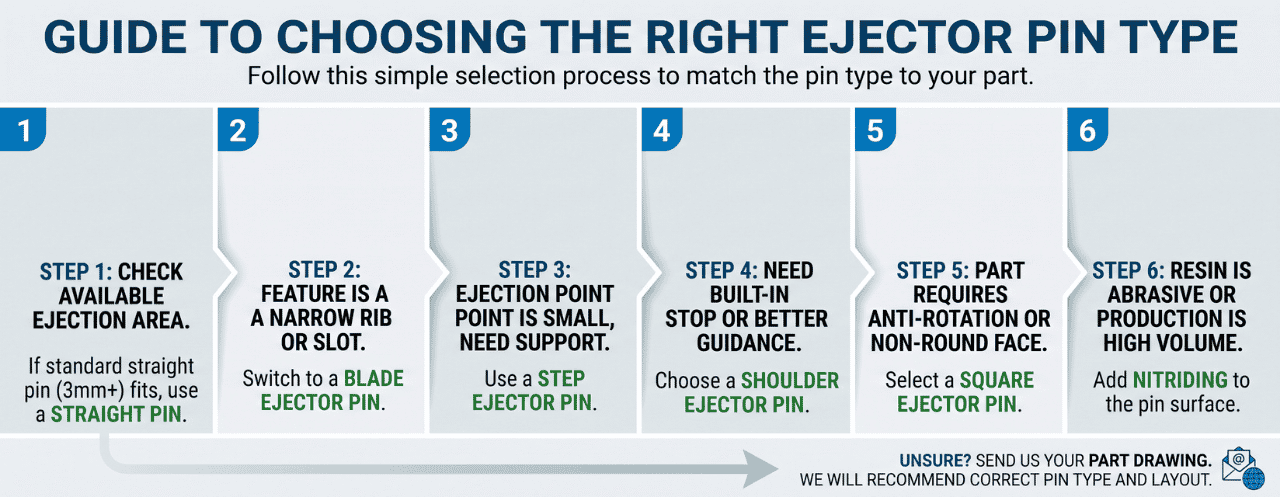
Follow this simple selection process to match the pin type to your part.
Step 1: Check the available ejection area. If a standard straight pin of 3 mm or larger fits, use a straight pin.
Step 2: If the feature is a narrow rib or slot, switch to a blade ejector pin.
Step 3: If the ejection point is small but you need support behind it, use a step ejector pin.
Step 4: If you need a built-in stop or better guidance, choose a shoulder ejector pin.
Step 5: If the part requires anti-rotation or a non-round ejector face, select a square ejector pin.
Step 6: If the resin is abrasive or the production volume is high, add nitriding to the pin surface.
If you are still unsure, send us your part drawing. We will recommend the correct pin type and layout for your mold.
FAQ
What are the main types of ejector pins?
The main types are straight, step, shoulder, blade, square, and nitrided ejector pins. Each type has a different geometry or surface treatment for specific ejection needs.
How do ejector pin types differ?
They differ in shape, contact area, guidance features, and surface hardness. Straight pins are uniform round pins. Step pins have a small tip and larger shaft. Shoulder pins have a larger diameter shoulder. Blade pins are flat. Square pins are non-round. Nitrided pins have a hardened surface.
Which ejector pin should I choose?
Choose a straight pin for general use. Choose a blade pin for narrow ribs. Choose a step pin for small ejection points with high load. Choose a shoulder pin for stroke control. Choose a square pin for anti-rotation. Add nitriding for abrasive resins or long runs.
When should I use a step ejector pin?
Use a step ejector pin when the ejection point is too small for a standard straight pin, and a smaller straight pin would be too weak or too flexible under ejection load.
When is a blade ejector pin better than a round ejector pin?
A blade ejector pin is better when the part feature is too narrow for a round pin, such as a thin rib or slot. The flat blade distributes the ejection force along a line instead of a small point.
What type of ejector pin is best for injection molding?
There is no single best type. Straight ejector pins are the best default choice for most molds. Other types are used when the part geometry or ejection conditions require a specific geometry or surface treatment.
Get Help Selecting Your Ejector Pin Type
Send us your part drawing or 3D file. Our engineers will review the geometry and recommend the right ejector pin type, size, and layout—free of charge.