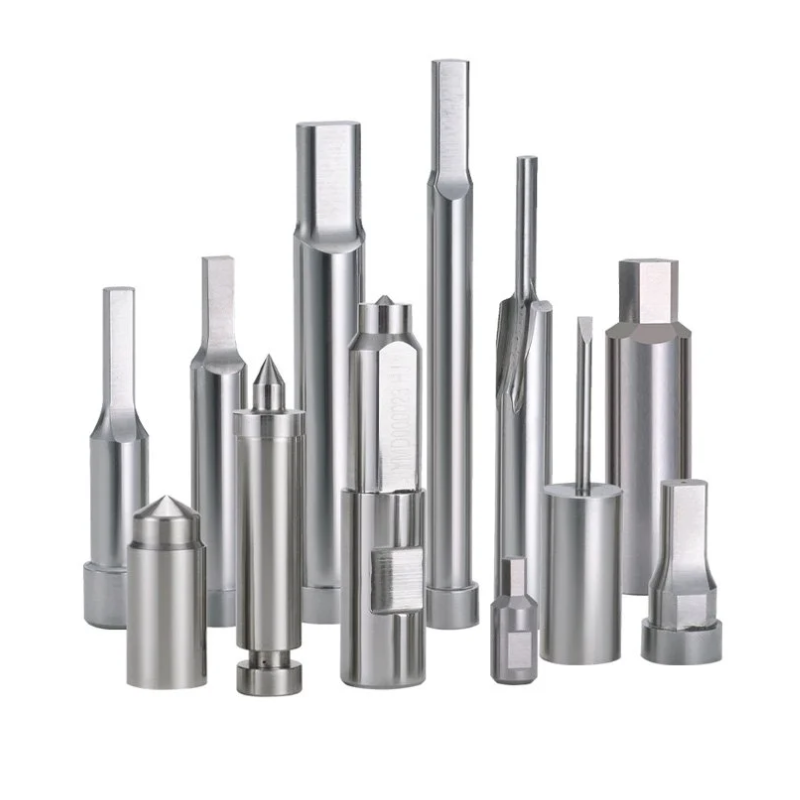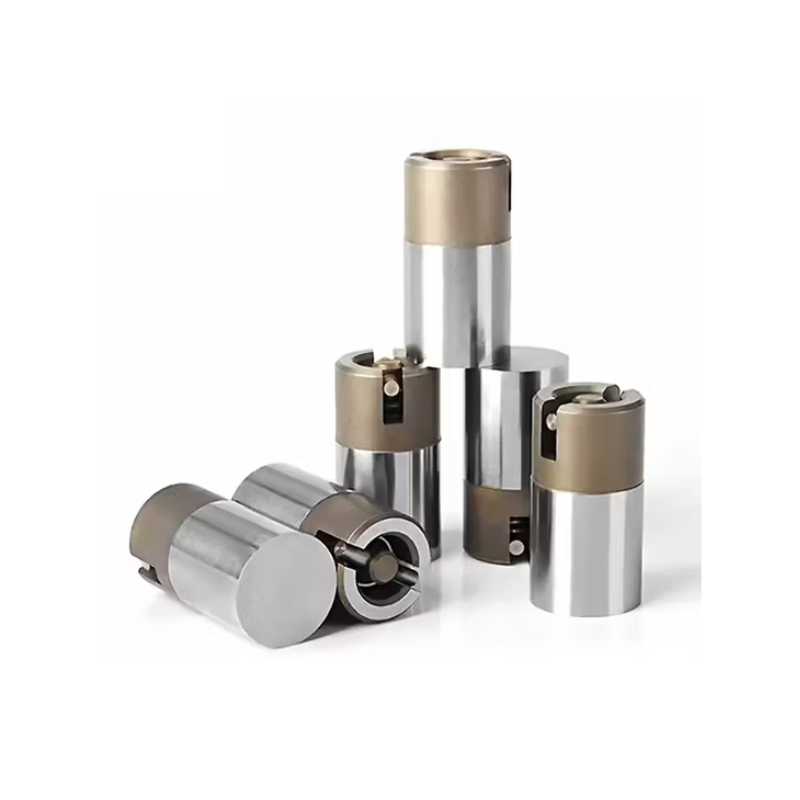
Choosing an ejector pin material is not about picking the hardest option. It’s about matching hardness, toughness, and wear resistance to the specific pin diameter, length, resin, and production volume. The right material keeps the pin from bending, breaking, or wearing too quickly.
For most molds, start with SKD61. If the pin tip is below 2 mm or the pin is long and slender, use SKD61 with nitriding instead of SKH51. SKH51 works well for larger diameters and high-wear applications, but it is more brittle. If you run abrasive resins or high cycle counts, consider a coated or nitrided surface. Always match material to the actual failure risk—bending, wear, or breakage.
What Are the Most Common Ejector Pin Materials?
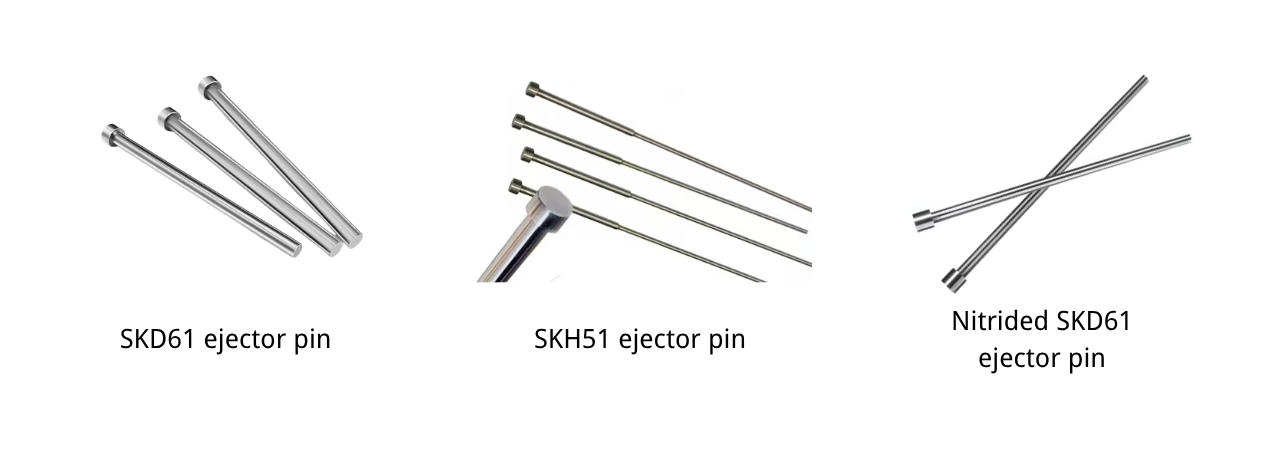
Most injection mold ejector pins are made from one of three material families: hot-work tool steel, high-speed steel, or surface-treated hot-work steel. The most common grades you will see from suppliers are SKD61, SKH51, and nitrided SKD61.
- SKD61 — a hot-work tool steel with a good balance of toughness and wear resistance. It is the default choice for general-purpose ejector pins.
- SKH51 — a high-speed steel with higher hardness and wear resistance than SKD61, but lower toughness. It is better for abrasive conditions but risky for small diameters.
- SKD61 + Nitriding — SKD61 with a hardened surface layer. The core remains tough, while the surface resists wear. This is often the best choice for small step pins or long pins.
Some suppliers also offer coatings such as TiN or DLC. Still, these are usually applied to the base material to solve specific friction or galling problems, not as a replacement for material selection.
Key Differences: SKH51 vs SKD61 vs Nitrided SKD61
The table below compares the three most common ejector pin material options.
| Comparison Item | SKH51 | SKD61 | SKD61 + Nitriding |
|---|---|---|---|
| Material type | High-speed steel | Hot work tool steel | Hot work tool steel + surface hardening |
| Typical hardness | 58–60 HRC | 50–55 HRC | Surface: 900 HV or higher; core: 40–45 HRC |
| Wear resistance | High | Moderate | High on surface, moderate in core |
| Toughness | Lower; small tips may fracture | Good; handles side load better | Core remains tough; surface hardened |
| Bending resistance | Depends on diameter; hard but brittle | Good; more forgiving for slender pins | Improved surface hardness; bending resistance mainly from core |
| Heat resistance | Good | Good; better thermal fatigue resistance | Improved surface heat and wear resistance |
| Suitability for small diameters (<2 mm) | Use with caution | More suitable | Preferred |
| Cost | Generally higher | Moderate | Slightly higher than non-nitrided SKD61 |
These values are typical ranges, not absolute specifications. Actual hardness and performance depend on the supplier, heat treatment, and pin dimensions.
When Should You Use SKD61 Ejector Pins?
Use SKD61 as your default material when the pin diameter is 2 mm or larger, the ejection load is moderate, and the resin is not highly abrasive. SKD61 gives you enough toughness to survive slight side loads and enough wear resistance for standard production runs.
We use SKD61 in most straight ejector pins and many step pins where the tip is not extremely small. It is also easier to machine and more cost-effective than SKH51, which makes replacement simpler.
When Should You Use SKH51 Ejector Pins?
Use SKH51 when wear resistance is the main concern and the pin diameter is large enough to avoid brittle failure. For pins above 3 mm in diameter, SKH51 can provide excellent service life in high-cycle molds or with glass-filled resins.
However, avoid SKH51 for tips below 2 mm. At that size, the pin is already highly stressed, and the lower toughness of SKH51 increases the risk of snapping at the transition or at the ejector plate.
A practical rule: if the pin is 3 mm or larger and you are seeing rapid tip wear with SKD61, upgrading to SKH51 is reasonable. If the pin is below 2 mm, do not make that upgrade—use nitrided SKD61 instead.
When Should You Use Nitrided SKD61 Ejector Pins?
Use nitrided SKD61 when you need a hard, wear-resistant surface but cannot afford a brittle core. This is the best option for small-diameter step pins, long slender pins, and applications with abrasive resins or high cycle counts.
The key advantage is that the core stays tough while the surface hardens. So the pin can handle side loads without breaking, but the tip and wear surfaces resist abrasion.
One detail you need to confirm with your supplier: nitriding depth is usually controlled by the tip diameter. The larger shaft behind a step pin may have a lower surface hardness than the tip. If you need full-length wear resistance, specify that clearly.
How Does Ejector Pin Diameter Affect Material Choice?
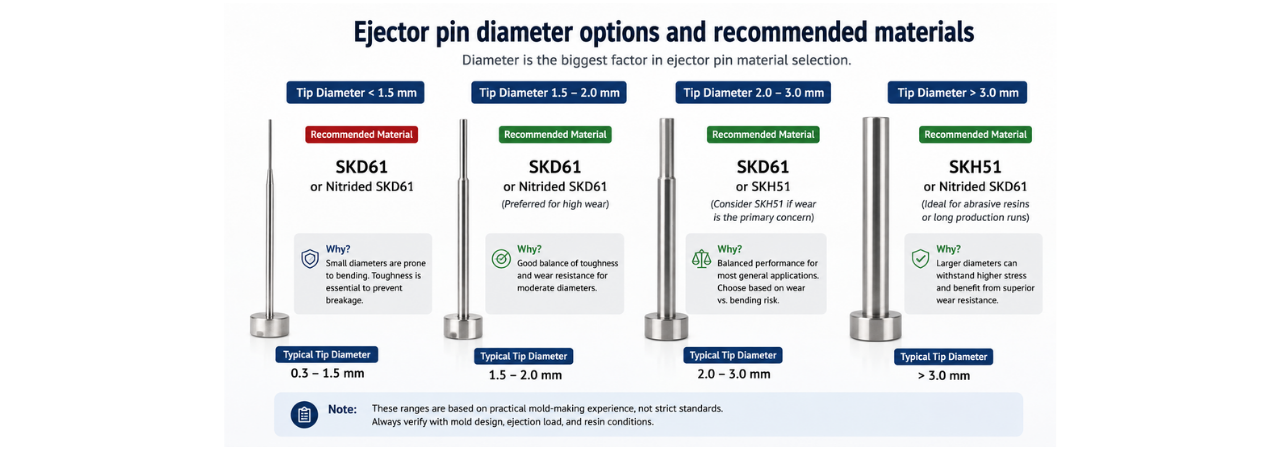
Diameter is the biggest driver of material selection. Small diameters concentrate stress on a smaller cross-section, so toughness matters more than hardness. Large diameters can tolerate harder, more wear-resistant materials because they have more volume to absorb stress.
- For tip diameters below 1.5 mm, avoid SKH51. Use SKD61 or nitrided SKD61, and add guidance if possible.
- For tip diameters from 1.5 mm to 2.0 mm, SKD61 is the default. Nitrided SKD61 is preferred for high wear.
- For tip diameters from 2.0 mm to 3.0 mm, SKD61 works well. SKH51 can be considered only if wear is a bigger problem than bending.
- For tip diameters above 3.0 mm, SKH51 becomes a practical option, especially for abrasive resins or long production runs.
These are not hard limits, but they reflect what we have seen in real molds. The failure mode changes with diameter, and the material should follow that change.
How Does Plastic Material Affect Ejector Pin Material Selection?
The resin you are molding has a direct impact on which ejector pin material you should choose.
- Abrasive resins, such as glass-filled nylon or PBT, wear pin tips quickly. You need a harder surface—SKH51 or nitrided SKD61.
- High-temperature resins, such as PEEK or PPS, run hot and can cause thermal fatigue. SKD61 has good thermal fatigue resistance and is often preferred.
- Soft or sticky resins, such as TPE or soft PP, do not wear pins quickly, but they can create high friction and side loads. Toughness matters more than hardness, so SKD61 is usually the right choice.
- High-shrinkage resins grip the core harder and require more ejection force. This increases bending risk, so you need a tough core—nitrided SKD61 works well.
Do not choose a material based only on the resin name. Look at the specific formulation, fillers, and molding conditions.
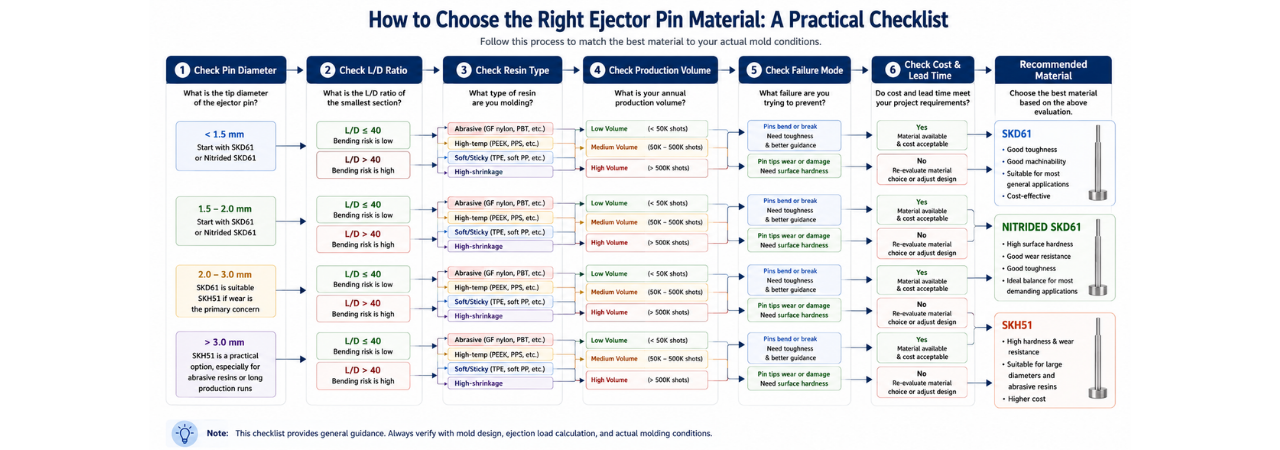
How to Choose the Right Ejector Pin Material: A Practical Checklist
Use this checklist to match material to your actual mold conditions.
1. Check the Pin Diameter
If the tip is below 2 mm, start with SKD61 or nitrided SKD61. Do not use SKH51 unless the pin is short and well guided.
2. Check the Pin Length and L/D Ratio
Calculate the length-to-diameter ratio of the smallest section. If L/D exceeds 40, bending risk is high. Choose a material with good toughness—SKD61 or nitrided SKD61—and add guidance if needed.
3. Check the Resin Type
Abrasive resins need surface hardness. Use SKH51 for larger pins or nitrided SKD61 for smaller pins. Non-abrasive resins can usually run fine with standard SKD61.
4. Check the Production Volume
For high cycle counts, invest in wear resistance. Nitrided SKD61 or SKH51 can pay back through longer pin life. For prototype or low-volume molds, standard SKD61 is often enough.
5. Check the Failure Mode You Are Trying to Prevent
If you are replacing pins that bent, you need more toughness or better guidance—not harder material. If the tips are wearing, you need surface hardness. Match the material to the actual failure.
6. Check Cost and Replacement Lead Time
SKH51 and coated pins cost more and may have longer lead times. For standard diameters, keep SKD61 in stock. Use higher-cost materials only where the application justifies it.
Common Ejector Pin Material Mistakes
Most material-related pin failures come from choosing hardness without thinking about toughness or guidance. Here are the mistakes we see most often.
| Mistake | Engineering Consequence |
|---|---|
| Using SKH51 for tips below 2 mm | Brittle fracture at the transition or head |
| Choosing material without checking L/D | Bending even with a hard pin |
| Ignoring resin abrasiveness | Rapid tip wear and shorter service life |
| Specifying nitriding without confirming depth | Uneven hardness along the pin length |
| Focusing only on hardness | Hard pin snaps instead of bending |
| Using the same material for all pins | Some pins wear fast while others are over-specified |
A harder pin is not always a better pin. The material must survive the real stress pattern in your mold.
FAQ
What is the best ejector pin material for general injection molding?
For most general-purpose molds, SKD61 is the best starting point. It offers a good balance of toughness and wear resistance at a reasonable cost.
Is SKH51 stronger than SKD61?
SKH51 is harder and more wear-resistant, but it is not stronger in terms of toughness. For small diameters or long slender pins, SKD61 is usually the safer choice.
Can I use nitrided SKD61 for small step pins?
Yes. Nitrided SKD61 is often the best option for small step pins because it keeps a tough core while providing a hard, wear-resistant surface.
How do I know if I need a coated ejector pin?
Consider a coating if you have galling, sticking, or high friction inside the pin bore. Coatings like TiN or DLC reduce friction, but they do not replace proper material selection.
What hardness should ejector pins be?
It depends on the material and application. SKD61 is typically 50–55 HRC, SKH51 is 58–60 HRC, and nitrided SKD61 has a surface hardness of 900 HV or higher with a tougher core.
Does ejector pin material affect mold maintenance?
Yes. A material with poor wear resistance will require more frequent pin replacement. Choosing the right material from the start reduces downtime and maintenance cost.
Final Thoughts
Ejector pin material selection is not about picking the hardest grade. It’s about choosing the material that survives your specific combination of pin diameter, length, resin, load, and cycle count.
If you are unsure, start with SKD61. Use nitrided SKD61 for small or slender pins, and consider SKH51 only for larger, wear-critical pins. Always match the material to the failure mode you are trying to prevent.
At HTX Precision, we supply custom ejector pins in SKD61, SKH51, and nitrided SKD61, with diameters from 1.0 mm to 25 mm. Send us your part drawing or pin dimensions. Our engineers will help you select the right material and surface treatment for your mold.