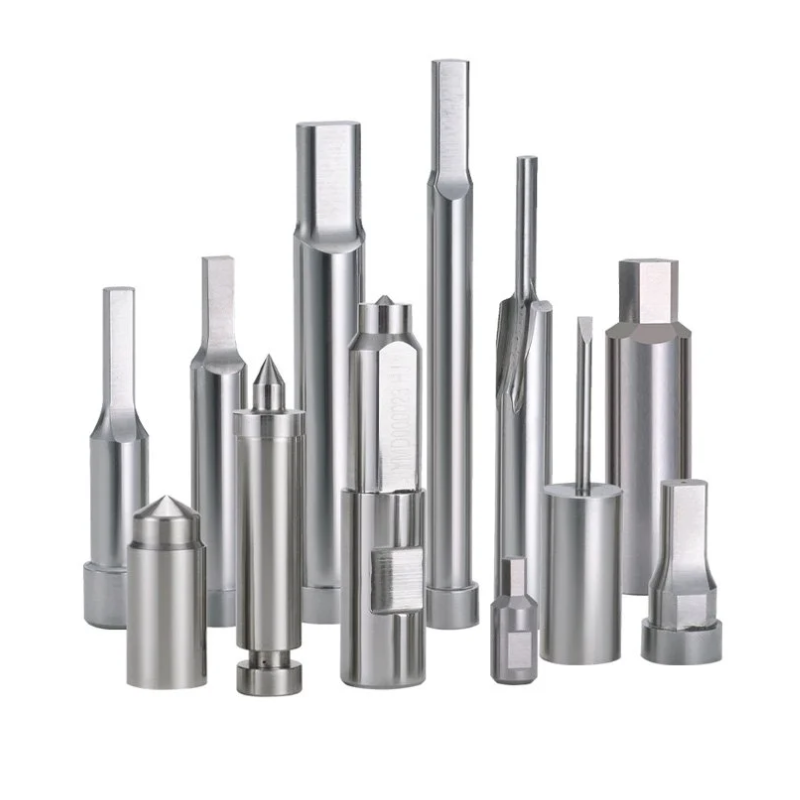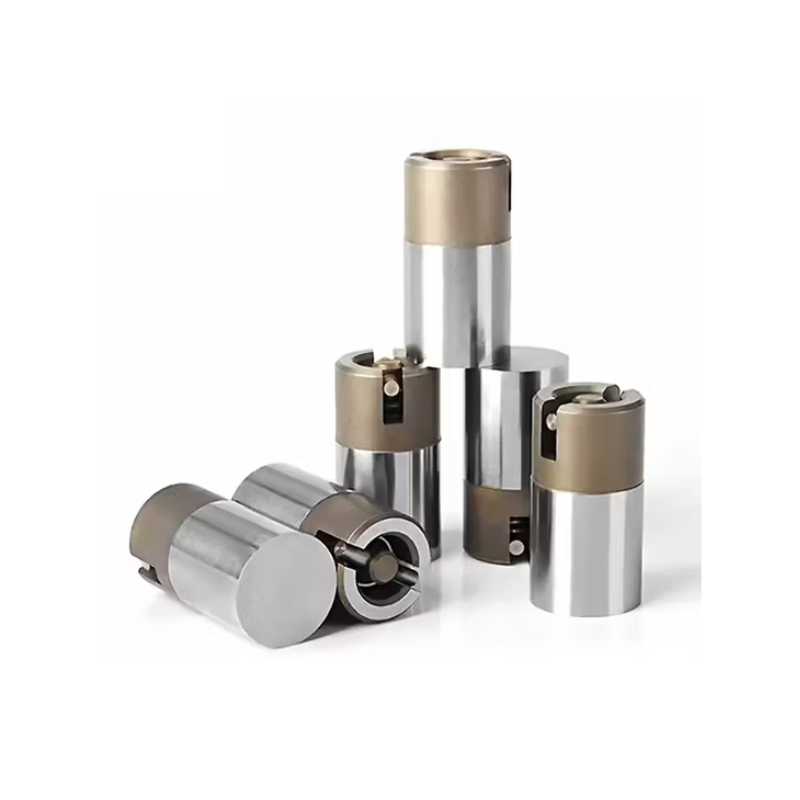
Ejector pins and ejector sleeves are both mold components used to eject molded parts from an injection mold, but they have different structures and are suited to different part geometries. An ejector pin is a solid cylindrical component that applies ejection force at a specific point. In contrast, an ejector sleeve is a hollow cylindrical component that surrounds a core pin and provides a larger annular ejection surface around features such as bosses and deep cylindrical cores.
Quick Answer: Use an ejector pin when point-based ejection is suitable, and the part has flat or solid areas for pin contact. Use an ejector sleeve when the molded part has a cylindrical boss, deep core, or round feature that requires ejection around the circumference. The choice depends on part geometry, core design, ejection force distribution, and surface quality requirements.
What Is an Ejector Pin?
An ejector pin is a solid cylindrical rod installed in the ejector system. It pushes the molded part off the core during mold opening. Ejector pins are available in different diameters, lengths, and configurations, including straight, step, shoulder, and blade types.
For most conventional injection molding applications, ejector pins are the simpler and more widely used ejection solution. They work well when the ejection force can be applied at discrete points, and the part surface can accept a visible pin mark or the mark can be placed on a non-cosmetic area.
HTX Precision manufactures a range of ejector pins to suit different mold requirements:
- Straight Ejector Pins — general-purpose round pins for standard ejection.
- Step Ejector Pins — small tip with larger supporting shaft for restricted ejection points.
- Shoulder Ejector Pins — built-in shoulder for stroke control or guided applications.
- Blade Ejector Pins — flat blade geometry for narrow ribs and slots.
- Nitrided Ejector Pins — hardened surface for abrasive resins and high cycle counts.
What Is an Ejector Sleeve?
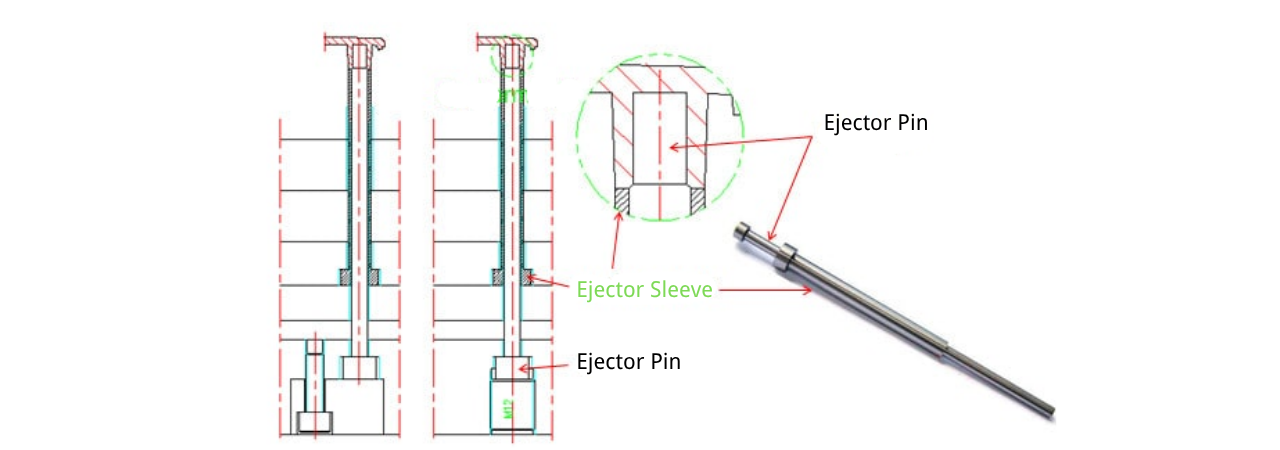
An ejector sleeve is a hollow cylindrical mold component that works around a core pin or core feature. During ejection, the sleeve slides along the fixed core pin and pushes on the part around the circumference of the boss or cylindrical feature.
The key structural difference is simple:
- Ejector Pin: Solid rod → applies force from a point or circular contact face.
- Ejector Sleeve: Hollow cylinder → surrounds the core pin → provides ejection around a boss or cylindrical feature.
HTX Precision also manufactures ejector sleeves to customer specifications. Common ejector sleeve dimensions include outer diameter, inner diameter, core pin diameter, wall thickness, and overall length. For custom sleeve requirements, send your drawing or sample for technical confirmation.
Ejector Sleeve vs Ejector Pin: Key Differences
The table below summarizes the main differences between the two ejection methods.
| Feature | Ejector Pin | Ejector Sleeve |
|---|---|---|
| Structure | Solid rod | Hollow cylindrical sleeve |
| Ejection method | Point / localized contact | Surrounding / annular contact |
| Core relationship | Independent of a core pin | Works around a core pin |
| Typical application | General ejection on flat or solid areas | Bosses, cylindrical features, deep cores |
| Contact area | Relatively localized | Larger, ring-shaped contact |
| Space requirement | Usually simpler | Requires sleeve/core arrangement |
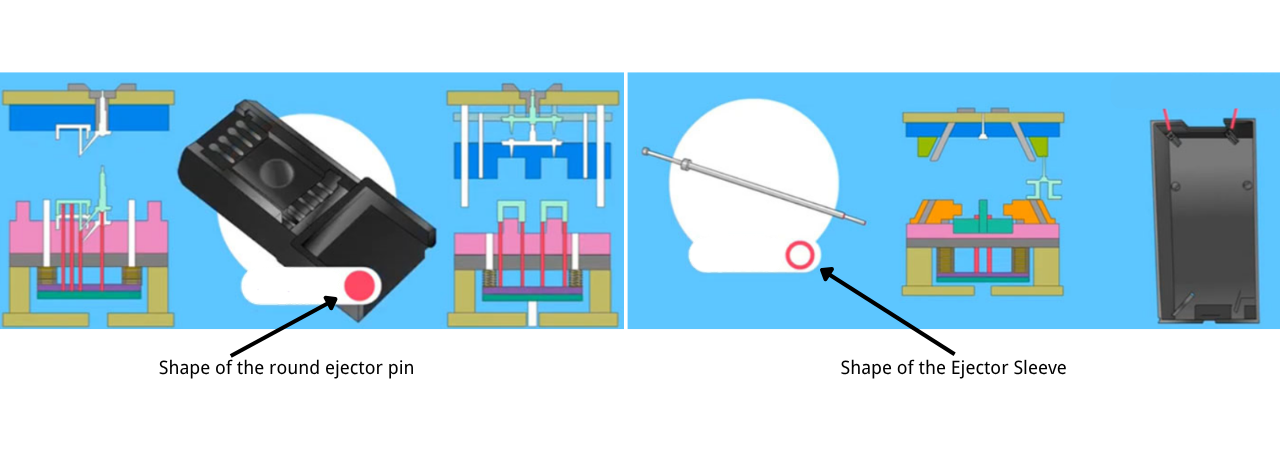
| Ejector mark | Round center mark | Ring mark, no center mark |
| Part distortion risk | Higher on thin cylindrical walls | Lower due to even force distribution |
| Design complexity | Generally simpler | Requires coordinated sleeve and core design |
| Cost | Lower | Higher due to additional components and machining |
| Common parts | Housings, covers, flat panels | Gears, connectors, caps, cylindrical parts |
These differences mean that the choice is not about which component is better. It is about which ejection method matches the part geometry and mold requirements.
When Should I Use an Ejector Pin?
An ejector pin is generally suitable when:
- Ejection can be applied at discrete points
- The molded surface allows pin contact without distortion
- The part geometry does not require surrounding ejection
- Standard pin installation is practical
- Multiple ejector points can distribute the ejection force
- Cost and simplicity are priorities
For many conventional injection molding applications, ejector pins remain the default and most cost-effective solution.
When Should I Use an Ejector Sleeve?
An ejector sleeve is preferred when the part geometry requires ejection around a cylindrical feature. Typical situations include:
- Deep bosses with thin walls
- Cylindrical cores that grip the part
- Parts molded around a core pin
- Features requiring surrounding ejection to prevent distortion
- Cases where a single pin would concentrate force excessively
- Applications where a center ejector mark is not acceptable
When a molded part forms around a cylindrical core, an ejector sleeve can push around the circumference of the feature rather than applying force through a single central point. This distributes the ejection force more evenly and reduces the risk of distortion, cracking, or surface defects on thin-walled round features.
Can an Ejector Sleeve Replace an Ejector Pin?
Not always. Ejector sleeves and ejector pins perform the same general function—molded-part ejection—but their structures and installation requirements are different. A sleeve is normally selected when the mold geometry requires ejection around a core feature, while a pin is suitable when localized ejection is sufficient.
Replacing a pin with a sleeve is not a simple dimensional swap. It requires:
- A core pin that can remain fixed during ejection
- Sufficient space for the sleeve wall and core pin
- A coordinated design between the sleeve, core pin, and ejector plate
- Proper alignment to prevent binding or flash
The choice depends on part geometry, core design, available mold space, and required ejection force.
How to Choose Between an Ejector Pin and Ejector Sleeve
Use this practical selection process as a starting point:
Step 1: Examine the part geometry. Does the molded feature surround a core pin or cylindrical core?
- Yes → Consider an ejector sleeve.
- No → Consider an ejector pin.
Step 2: Is surrounding ejection required to prevent distortion or center marks?
- Yes → An ejector sleeve is the appropriate choice.
- No → A standard ejector pin may be sufficient.
Step 3: Check the available mold space. Can the sleeve and core pin fit without interfering with cooling channels or other components?
- Yes → Proceed with sleeve design.
- No → Re-evaluate the ejection approach or modify the part geometry.
Step 4: Confirm the material and surface treatment. For small-sleeve walls or high-wear applications, nitrided SKD61 is often the best balance between surface hardness and core toughness.
Step 5: Validate the complete design. Check sleeve length, core pin alignment, clearance, and ejection stroke before finalizing.
Final selection should always be confirmed based on the complete mold structure and ejection requirements. If you are unsure, send us your part drawing. Our engineers will recommend the correct ejection approach.
Material Considerations for Ejector Sleeves and Pins
Both ejector pins and ejector sleeves are typically made from SKD61 or SKH51, with optional nitriding for abrasive resins or high cycle counts.
For ejector sleeves, material selection is critical because the sleeve wall is often thin. A sleeve must be tough enough to withstand ejection pressure without cracking, while also providing enough surface hardness to resist wear on the inner and outer surfaces.
Common material guidelines:
- SKD61 — good toughness and heat resistance; the default choice for most sleeves and pins.
- SKD61 + Nitriding — tough core with a hard, wear-resistant surface; preferred for thin-walled sleeves and abrasive resins.
- SKH51 — high hardness and wear resistance; suitable for larger sleeves or pins where brittleness is less of a concern.
For small-diameter sleeves or thin-walled designs, we generally recommend SKD61 or nitrided SKD61. The additional toughness reduces the risk of cracking under ejection load.
Size and Specification Differences
Specifying an ejector pin is relatively straightforward. You need the diameter, length, head dimensions, and material.
Specifying an ejector sleeve requires additional dimensions:
- Outer diameter
- Inner diameter
- Core pin diameter
- Wall thickness
- Overall length
- Flange or head dimensions
- Material and surface treatment
Because the sleeve must fit precisely over the core pin, the relationship between the inner diameter and core pin diameter is critical. Too much clearance causes flash and misalignment. Too little clearance causes binding and galling.
Common Mistakes When Choosing Between Sleeve and Pin
| Mistake | Consequence |
|---|---|
| Using a pin on a thin-walled cylindrical boss | Distortion, cracking, or visible center mark |
| Using a sleeve where a pin would work | Unnecessary cost and mold complexity |
| Ignoring core pin alignment | Sleeve binding, wear, or flash |
| Specifying a sleeve without checking wall thickness | Cracking under ejection load |
| Choosing material based only on hardness | Brittle failure on thin sleeve walls |
| Treating pin-to-sleeve replacement as a direct swap | Misalignment, interference, or ejection failure |
Most problems come from forcing a standard pin where a sleeve is needed, or from over-specifying a sleeve when a simple pin would do the job.
HTX Precision: Ejector Pins and Ejector Sleeves
HTX Precision manufactures both ejector pins and ejector sleeves to customer specifications.
Ejector Pin Range:
- Straight Ejector Pins
- Step Ejector Pins
- Shoulder Ejector Pins
- Blade Ejector Pins
- Square Ejector Pins
- Nitrided Ejector Pins
Ejector Sleeve Range:
- Custom Ejector Sleeves — manufactured to your outer diameter, inner diameter, length, and material requirements.
For ejector pin or ejector sleeve selection, send us your part drawing or mold design. Our engineers will recommend the correct ejection method and dimensions for your application.
FAQ
What is the main difference between an ejector sleeve and an ejector pin?
An ejector pin is a solid cylindrical component that applies ejection force at a specific point. An ejector sleeve is a hollow cylindrical component that surrounds a core pin and ejects around a boss or cylindrical feature.
Is an ejector sleeve stronger than an ejector pin?
Not necessarily. Strength depends on geometry, dimensions, material, and ejection requirements. A sleeve distributes force more evenly around a feature, but it is not automatically stronger than a pin in all applications.
When should I use an ejector sleeve instead of an ejector pin?
Use an ejector sleeve when the part has a cylindrical boss, deep core, or round feature that requires ejection around the circumference. Sleeves are also preferred when a center ejector mark is not acceptable or when a pin would distort a thin-walled feature.
Can I replace an ejector pin with an ejector sleeve?
It depends on the part geometry and mold design. Replacing a pin with a sleeve requires a fixed core pin, sufficient space, and a coordinated design. It is not a direct dimensional swap.
Are ejector sleeves more expensive than ejector pins?
Yes. Ejector sleeves require more components, including a core pin and a precisely machined hollow sleeve. They also require more machining time, so they cost more than a standard pin. The cost is justified when the part geometry requires them.
What material is best for ejector sleeves?
SKD61 is the most common material for ejector sleeves due to its good toughness and heat resistance. Nitrided SKD61 is preferred for thin-walled sleeves or abrasive resins. SKH51 can be used for larger sleeves where brittleness is less of a concern.
What dimensions are needed to order an ejector sleeve?
You need the outer diameter, inner diameter, core pin diameter, wall thickness, overall length, flange dimensions, material, and surface treatment. A drawing is strongly recommended for custom sleeves.
Can ejector sleeves be custom made?
Yes. HTX Precision manufactures custom ejector sleeves to your specifications. Send your drawing or sample for technical confirmation.