
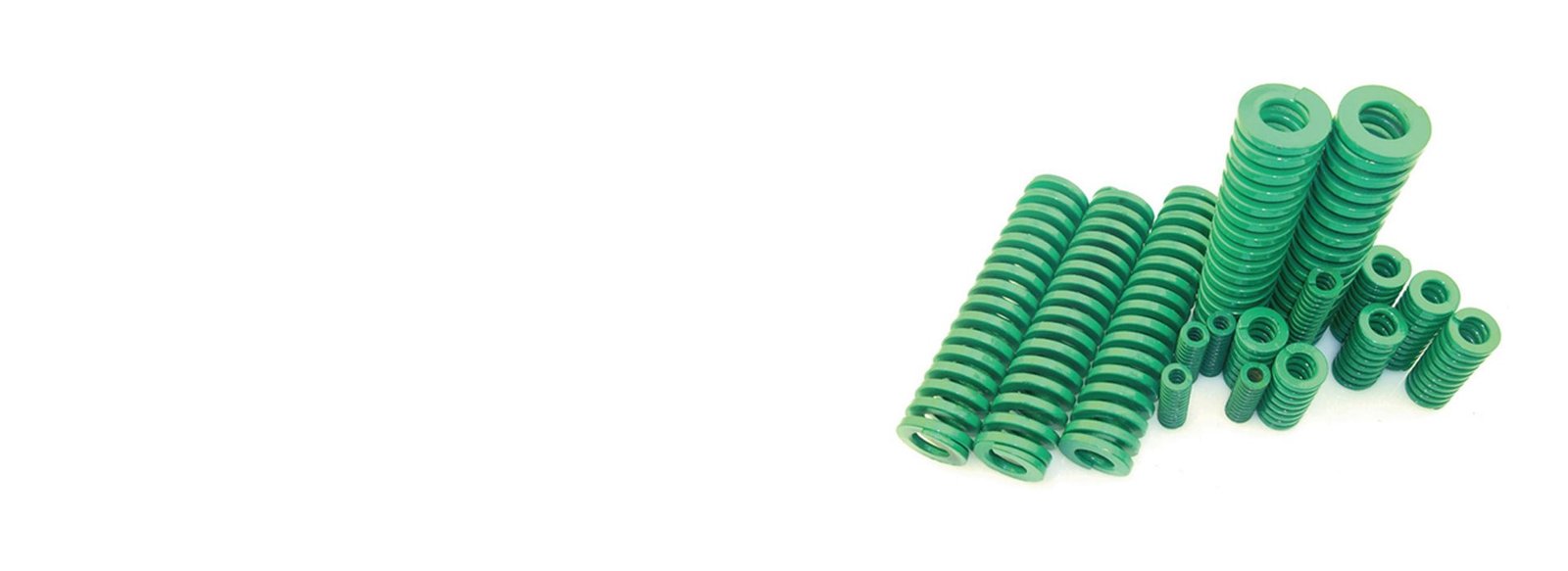
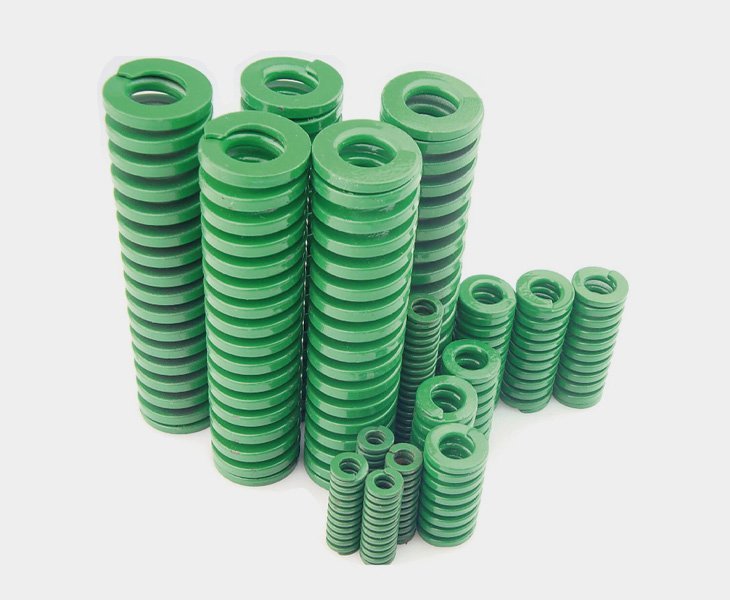
What Are Green Die Springs?
Green die springs are classified as heavy-duty die springs; the focus is not on achieving high-intensity thrust force, but rather on delivering stable, controllable rebound and precise stroke control. These springs are particularly suited for precision mold structures that are sensitive to impact and vibration and cannot tolerate excessive shock.
More importantly, light duty does not imply weak performance. Blue die springs provide a consistent and uniform rebound force within a defined stroke, ensuring smooth and reliable mold operation. They serve as critical functional components in precision molds.
HTX can provide professional spring selection support. Contact us now, our professional engineer will give you a suitable selection and quotation.
The Performance of HTX Green Die Springs
Green mold springs achieve an exceptional balance between load capacity, compression control, and service life, specifically optimized for high-intensity, high-frequency mold applications.

Delivers outstanding load-bearing capability for primary mold stripping or critical pressurization tasks.

Maintains linear compression characteristics even within limited travel, enabling precise motion control.

Retains initial spring force after repeated compression cycles, ensuring consistent production outcomes.

Optimized for confined mold interiors, delivering reliable performance in tight spaces.
Typical Applications of Green Die Springs
Green die springs are designed for applications requiring higher spring force and longer service life, especially in situations where medium-duty springs might experience premature fatigue failure.
They excel in applications such as heavy-duty stripper plates, thick material forming tools, and high-tonnage press dies, where a strong return force is needed within a limited stroke.
Green die springs prioritize force stability and durability in their design, rather than return speed or flexibility, making them a reliable choice for your heavy-duty, high-load dies.
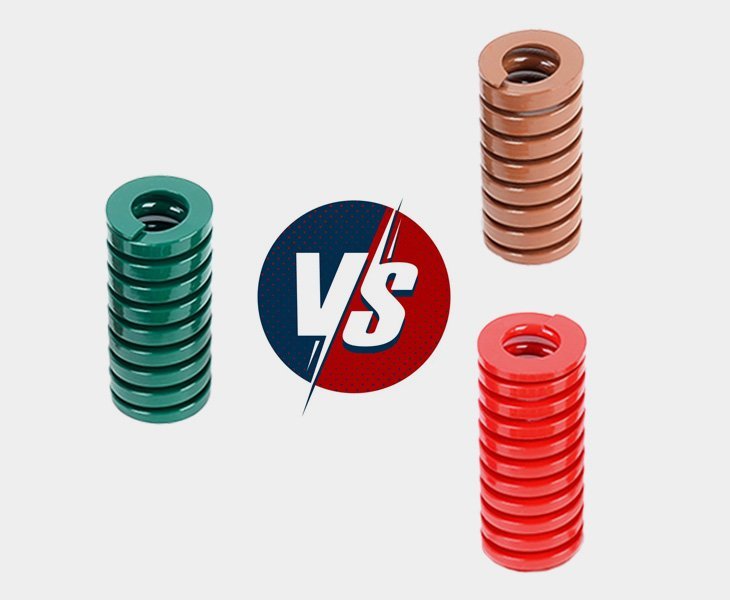
Green Die Springs vs Other Load Ratings
Understanding load boundaries is key to optimizing mold design, preventing both premature spring failure and unnecessary over-engineering.
Red die springs (medium load) may experience fatigue failure under sustained high-load conditions, whereas green die springs demonstrate superior stability under identical conditions. Compared to brown die springs (heavy-duty), green die springs deliver sufficient load-bearing capacity without increasing mold wear risks due to excessive force.
In general, when you are choosing between load capacity and durability for your heavy-duty molds, green mold springs offer the best balance.
Incorporate appropriate guide mechanisms into mold design to effectively minimize the impact of lateral loads on spring performance. Simultaneously, ensure spring loading aligns with the overall force distribution of the mold to achieve uniform and stable elastic support.
When the load capacity required during use exceeds the range that red die springs can safely provide under repeated cycles.
Yes, they are specifically designed to deliver high thrust within limited compression space.
Common causes include excessive compression, lateral loading, and improper guidance.
Green die springs are better suited for load critical applications rather than extreme high speed conditions.