
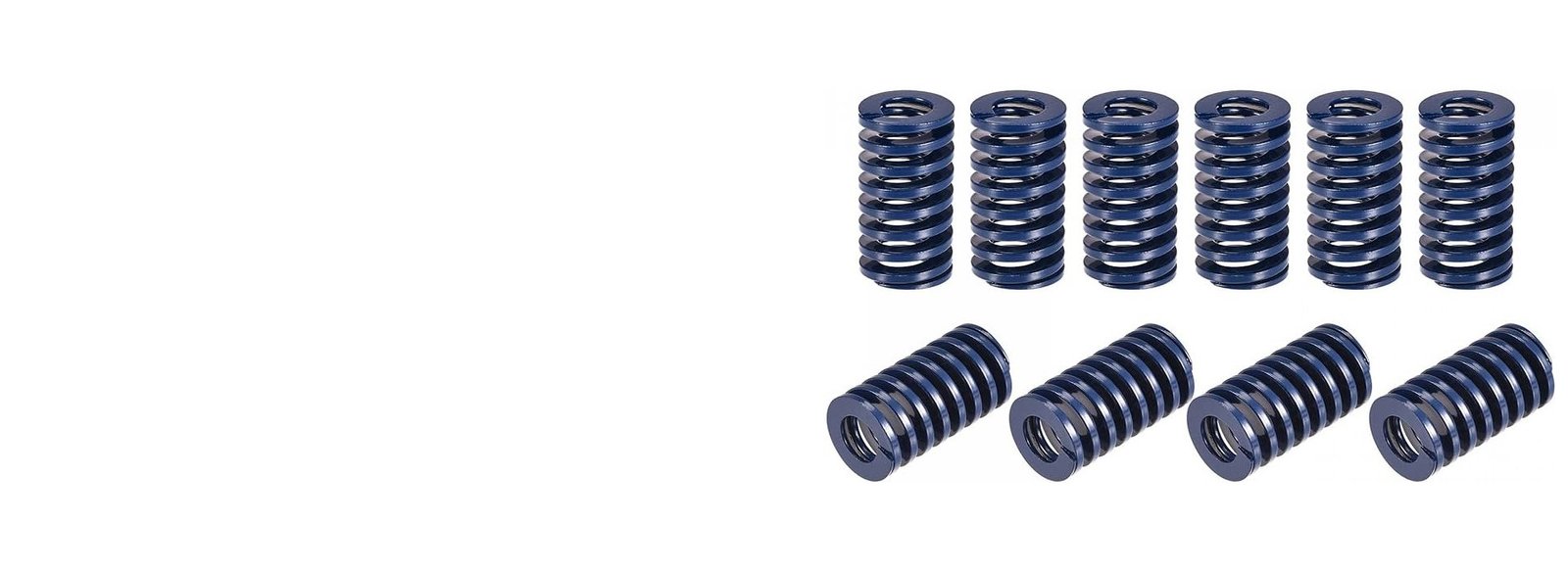
What Are Blue Die Springs?
Blue die springs are classified as light-duty mold springs; the focus is not on achieving high-intensity thrust force, but rather on delivering stable, controllable rebound and precise stroke control. These springs are particularly suited for precision mold structures that are sensitive to impact and vibration and cannot tolerate excessive shock.
More importantly, light duty does not imply weak performance. Blue die springs provide a consistent and uniform rebound force within a defined stroke, ensuring smooth and reliable mold operation. They serve as critical functional components in precision molds.
HTX can provide professional spring selection support.
The Controllable Performance of HTX Blue Die Springs
The blue die spring can provide a linear load curve, enabling higher stroke utilization while effectively reducing rebound impact. This enhances mold operation stability and extends service life.

Blue die spring deliver continuous, smooth output force, especially for stable light loads requiring applications. They will keep reliable response performance even under high frequency operating conditions.

In the confined space, the spring’s compression is suitable for short stroke structures, the blue die springs enable precise, effective ejection and reset actions within compact layouts.

By cushioning transient impacts during ejection and retraction, it effectively absorbs energy from mold vibrations, significantly reducing operational noise. This enhances workplace comfort and overall equipment stability..

Balanced load distribution and low fatigue characteristics minimize wear on critical mold components during operation. Maintaining precision over extended use extends the overall service life of precision molds.
Structural Applications of the Blue Die Springs
Blue Die Spring is commonly used in mold structures to provide a stable spring force for precision positioning mechanisms, assisting small slides in achieving accurate repositioning. It also serves as a critical elastic component in mold buffering and anti-vibration systems, effectively absorbing mold impacts and dampening vibrations to ensure smooth mold operation.
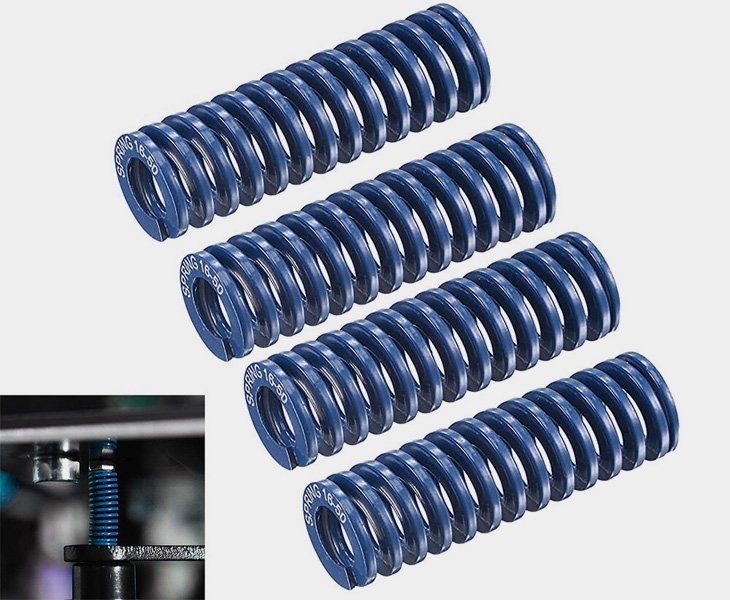
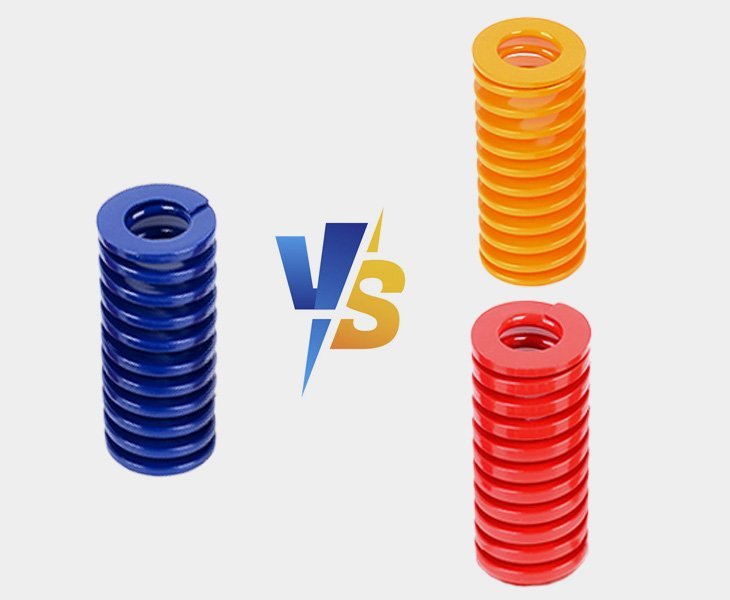
Blue Die Springs vs Other Load Ratings
The Blue Die Springs offer significant advantages in performance balance.
Compared to the Yellow Die Spring series, it provides more stable working clearance and higher load reliability.
Compared to the higher load Red Die Spring series, the Blue Die Spring series is better suited for mold applications requiring precise control and continuous, stable actuation, achieving a superior balance between load capacity and precision control.
Blue die springs are classified as light duty mold springs, making them more suitable for high-frequency, short-stroke, low-stress applications rather than high-load continuous compression scenarios.
They can be used interchangeably when stroke and space permit. However, blue die springs possess higher initial elastic force and are typically employed in light load structures requiring more stable rebound.
They are frequently found in alignment mechanisms, auxiliary ejection, light duty clamping, or positioning applications, but not in primary load bearing areas.
Generally, compression should not exceed approximately 30–32% of the free length to ensure spring longevity and stability.