
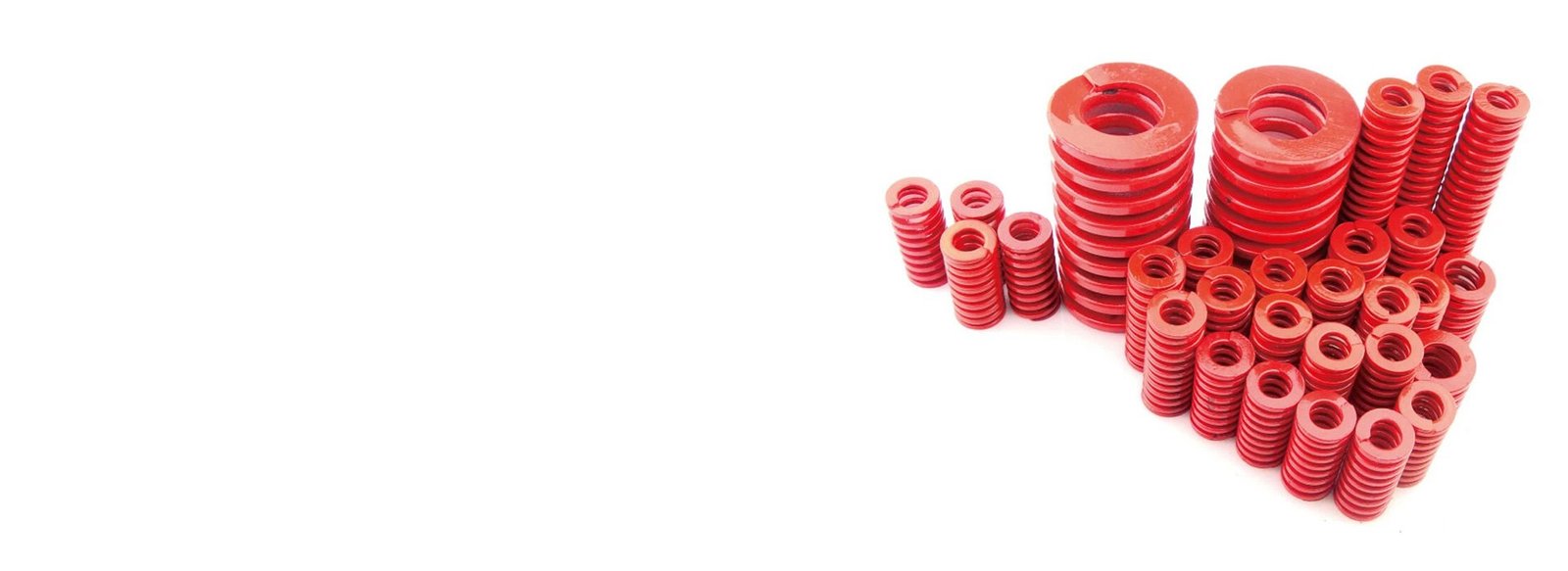
What Are the Red Die Springs?
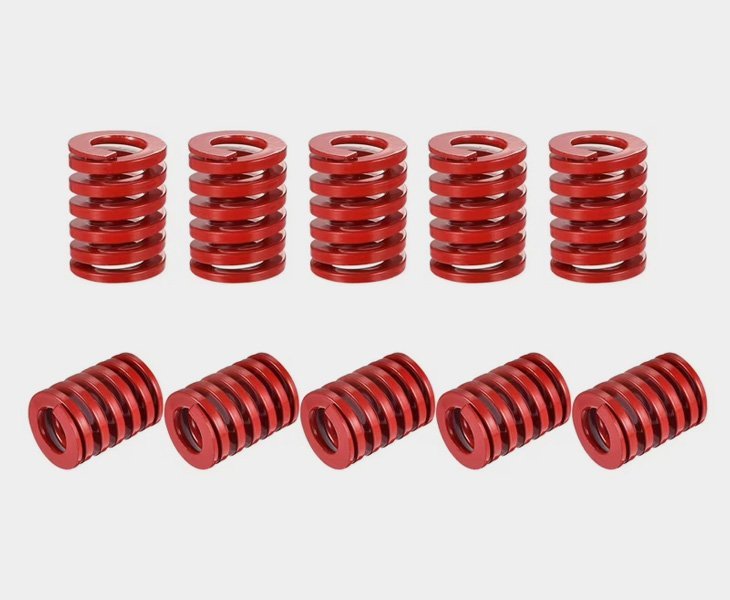
Red die springs(TM) are classified as medium-load die springs in many Japanese mold spring systems, the preferred default choice for standard operating conditions and the safest option with the lowest risk of errors. Mold compression springs, classified as Medium Duty, are used in mold systems that require a certain level of compression force but not under extremely high loads.
They demand higher spring life and stability than Light Duty springs, operating in environments with high usage frequency and numerous cycles. Positioned between Blue die Springs and Green Die Springs, they represent one of the most widely used load ratings in practical mold applications.
If you are looking for a medium-duty die spring manufacturer, contact HTX for a size recommendation.
The Structure of HTX Red Die Springs
When you do not know how to choose the die springs, usually you can choose from the red die spring, then you can adjust upward or downward based on the actual operating conditions.

Moderate compression ratio facilitates easier matching with standard mold dimensions.

Suitable compression ratio, approximately 25% of total free length (reference value)

Stable and controllable mold rebound speed results in more consistent product quality.

Suitable for applications requiring a high number of cycles and high frequency operation.
Why Choose HTX as Your Red Mold Springs Manufacturer?
In real mold operating conditions, springs that are too light may exhibit insufficient rebound and poor stability, while springs that are too heavy can cause accelerated part wear due to excessive force on the mold. Red Die Springs strike the perfect balance—providing adequate compression force without imposing excessive tension on the mold base or guide system.
They also integrate seamlessly with standard mold structures. This is precisely why Red is the default preferred load rating in numerous mold designs.
- Precision Manufacturing – We provide consistent spring force and strict dimensional control.
- Quality Inspection – Before packaging, we need to perform loading testing and dimensional inspection.
- OEM Customization – If the standard size is not suitable for your mould, we can customize the sizes and specifications.
Red Die Springs vs Other Load Ratings
| Type | Load | Application |
| Blue | Light Load | Low force molds |
| Red | Medium Load | Standard mold applications |
| Green | Heavy Load | High force applications |
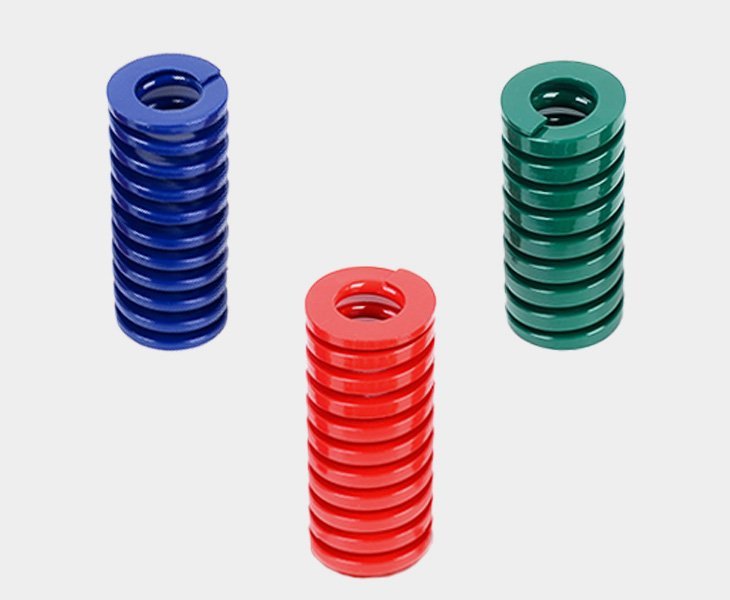
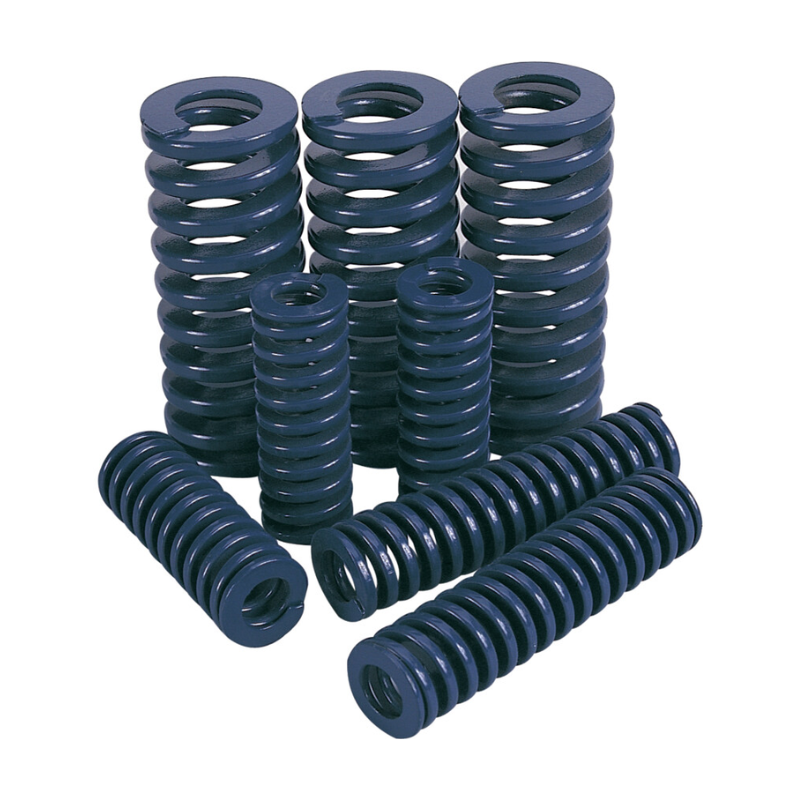
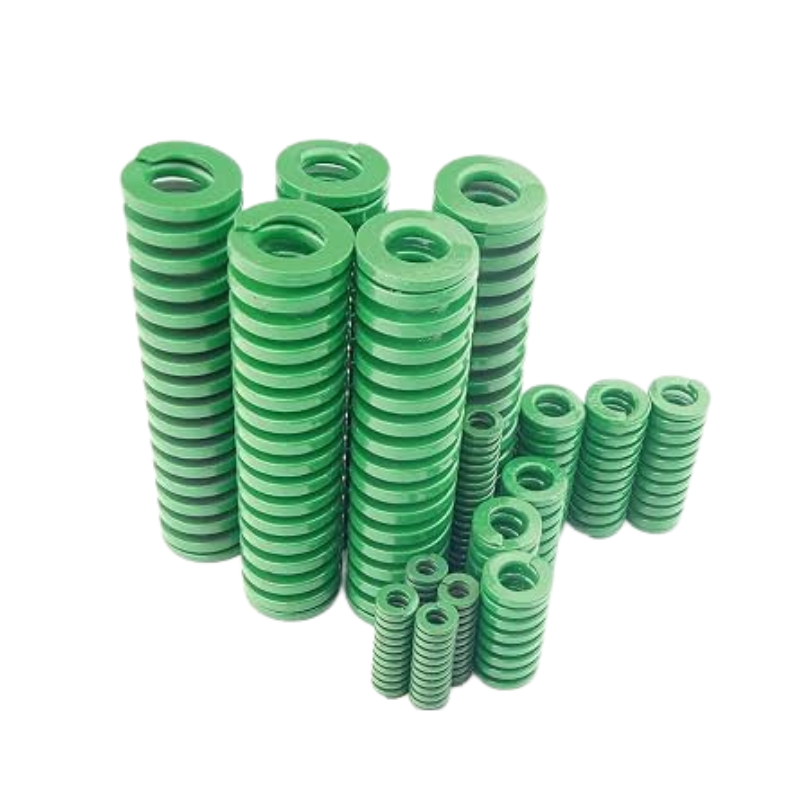
The Red Die Spring is specifically designed for standard mold requirements, achieving an optimized performance balance between the Blue (light load) and Green (heavy load) variants.
Compared to the Blue die spring, the Red die spring delivers higher compression force and more reliable actual load-bearing capacity, preventing insufficient rebound or unstable positioning.
Compared to the Green die spring, the Red die spring exerts less impact on mold structures. It ensures sufficient load capacity while extending service life, making it more suitable for most standard molds rather than extreme operating conditions.
Red Die Springs Measurement
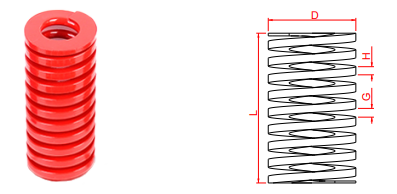
| Length(L) | |||||
| mm | 10 | 15 | 20 | 25 | 30 |
| Inch | 0.3937 | 0.5906 | 0.7874 | 0.9843 | 1.1811 |
| mm | 35 | 40 | 45 | 50 | 55 |
| Inch | 1.378 | 1.5748 | 1.7717 | 1.9685 | 2.1654 |
| mm | 60 | 65 | 70 | 75 | 80 |
| Inch | 2.3622 | 2.5591 | 2.7559 | 2.9528 | 3.1496 |
| mm | 85 | 90 | 95 | 100 | 125 |
| Inch | 3.3465 | 3.5433 | 3.7402 | 3.937 | 4.9213 |
| mm | 150 | 200 | 250 | 300 | |
| Inch | 5.9055 | 7.874 | 9.8425 | 11.811 | |
| External Diameter(D) | Linear Thickness(H) | Gap(G) | |||
| mm | Inch | mm | Inch | mm | Inch |
| 6 | 0.2362 | 1 | 0.0394 | 0.7 | 0.0276 |
| 8 | 0.315 | 1.2 | 0.0472 | 0.8 | 0.0315 |
| 10 | 0.3937 | 1.3 | 0.0512 | 1 | 0.0394 |
| 12 | 0.4724 | 1.7 | 0.0669 | 1.4 | 0.0551 |
| 14 | 0.5512 | 1.8 | 0.0709 | 1.6 | 0.063 |
| 16 | 0.6299 | 2.1 | 0.0827 | 1.8 | 0.0709 |
| 18 | 0.7087 | 2.4 | 0.0945 | 1.9 | 0.0748 |
| 20 | 0.7874 | 2.7 | 0.1063 | 2.2 | 0.0866 |
| 22 | 0.8661 | 3 | 0.1181 | 2 | 0.0787 |
| 25 | 0.9843 | 3.1 | 0.122 | 2.6 | 0.1024 |
| 27 | 1.063 | 3.3 | 0.1299 | 2.9 | 0.1142 |
| 30 | 1.1811 | 4 | 0.1575 | 3 | 0.1181 |
| 35 | 1.378 | 4.6 | 0.1811 | 2.7 | 0.1063 |
| 40 | 1.5748 | 5 | 0.1969 | 4.3 | 0.1693 |
| 50 | 1.9685 | 6.6 | 0.2598 | 4.5 | 0.1772 |
| 60 | 2.3622 | 7.6 | 0.2992 | 5.3 | 0.2087 |
| 70 | 2.7559 | 9.3 | 0.3661 | 7.8 | 0.3071 |
When selecting a red die spring, pay special attention to whether the outer diameter matches the spring hole, and ensure the natural extended length aligns with the actual compression stroke and required working load within the medium load range.
If the load approaches the upper limit, one should select the higher-capacity Green Die Springs.
In cases where the load is noticeably lower, Blue Die Springs become the more suitable choice.
They are generally used in pressure plates, ejector plates, or functional structures requiring stable medium spring force.
Within its recommended compression ratio range (approximately 25%), the red spring typically offers a good balance between longevity and stability.
Red Die Spring Selection Guide
| Step | Selection Key Points | Red Spring Note |
| 1 | Confirm Load Requirement Identify preload and end-of-stroke load; calculate the required spring rate; always account for shock and fatigue safety factors. | Start selection by back-calculating from the max. allowed compression ratio of 30%~32%. |
| 2 | Check Compression Stroke The working stroke must be less than the max. allowed compression; each color has a different ratio—red is the balanced choice. | Max. allowed ratio: 30% of free length (e.g., 100mm free length → max. 30mm compression) |
| 3 | Select Free Length Free length must fit the installation space and preload. Formula: Free Length = (Preload + Working Stroke) ÷ Allowed Ratio | In tight spaces, red is the top choice for compact design—shorter than yellow/blue, longer than green/brown. |
| 4 | Consider Cycle Frequency Frequency affects heat build-up and fatigue life; differentiate between standard (<200 SPM) and high-speed; derate for high cycling. | Standard life: 300k or 500k cycles; for high-speed, limit actual compression ratio to <25%. |
| 5 | Choose Suitable Spring Rating Match model to catalog curve; check hole diameter & guide rod fit to prevent buckling; verify if red is the optimal rating. | Red is the universal balanced choice for 80% of die applications. Go Green for heavier loads, Blue for lighter. |