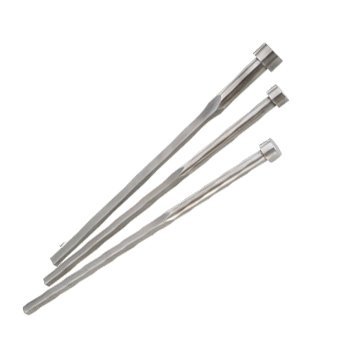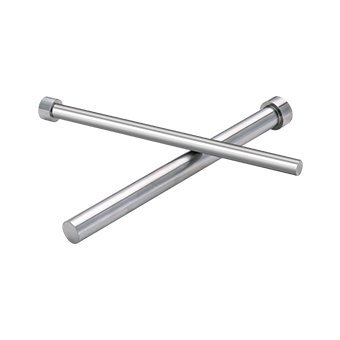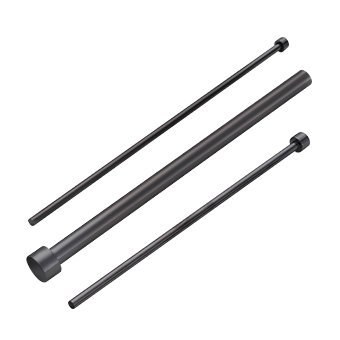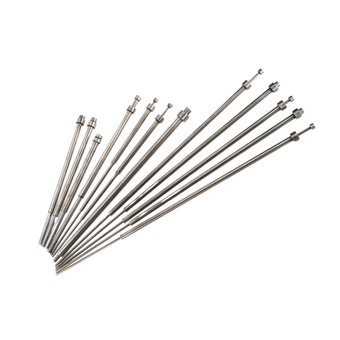
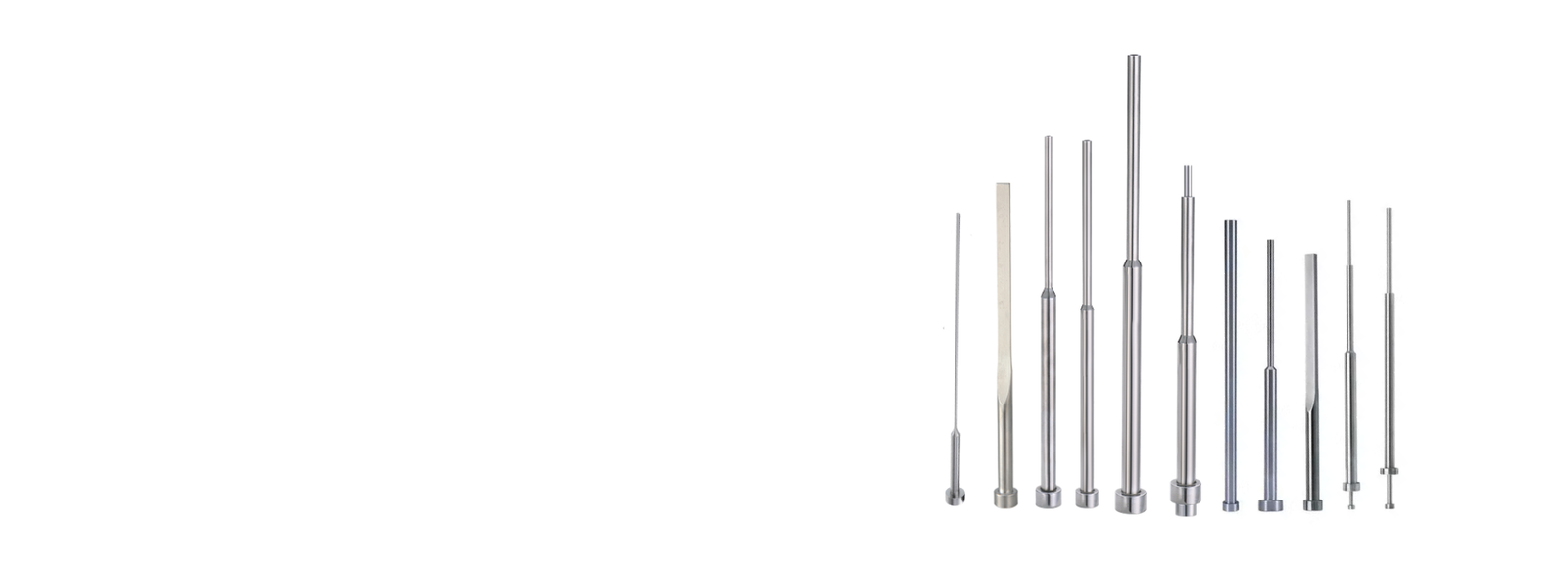
What is a Shoulder Ejector Pin?
A shoulder ejector pin is a specialized injection mold ejector pin with an integrated shoulder section designed to improve guiding stability, resist lateral loads, and maintain accurate linear movement during repeated ejection cycles.
Unlike standard straight ejector pins, shoulder ejector pins provide superior guiding stability in molds involving long-stroke movements or subject to unstable lateral loads. It is used to maintain controlled linear motion during mold ejection—not only to eject parts but also to ensure precise motion control within the mold system.
Shoulders help stabilize axial movement and reduce lateral loads during the ejection process, making them particularly suitable for applications involving long strokes or eccentric ejection. Standard (shoulderless) ejector pins cannot achieve these functions; they suffer from issues such as unstable lateral loads, the risk of bending, and inconsistent guidance—all of which lead to excessive wear, unstable ejection, and reduced mold reliability.
For this very reason, shoulder ejector pins are frequently used in high-precision molds and in applications involving unstable lateral loads. They eliminate the shortcomings of straight ejector pins by resisting lateral forces, distributing axial loads through the shoulder, and ensuring repeatable linear motion over millions of cycles. In the mold operation, the shoulder helps mitigate motion instability and enhances guidance consistency throughout repetitive cycling processes.
Engineering Applications of HTX Shouldered Ejector Pins

Shouldered pins resist deflection under long ejection strokes and uneven loads on large parts like bumpers and dashboards.

SKH51 or nitrided shouldered pins hold stroke accuracy over millions of cycles, extending maintenance intervals.

Uniform stroke control per cavity prevents micro-deformation that compromises terminal fit in high-density connectors.

Controlled ejection force at adhesion points releases deep ribs and textured parts without surface damage.
Surface Treatment Solutions for Long Pin Life
By subjecting the product surface to the following processes, we can effectively reduce the coefficient of friction, prevent seizing (galling), and extend the product’s service life:
- Surface Nitriding Treatment (HV800) — Effectively prevents seizing phenomena and significantly enhances the surface hardness of the pins.
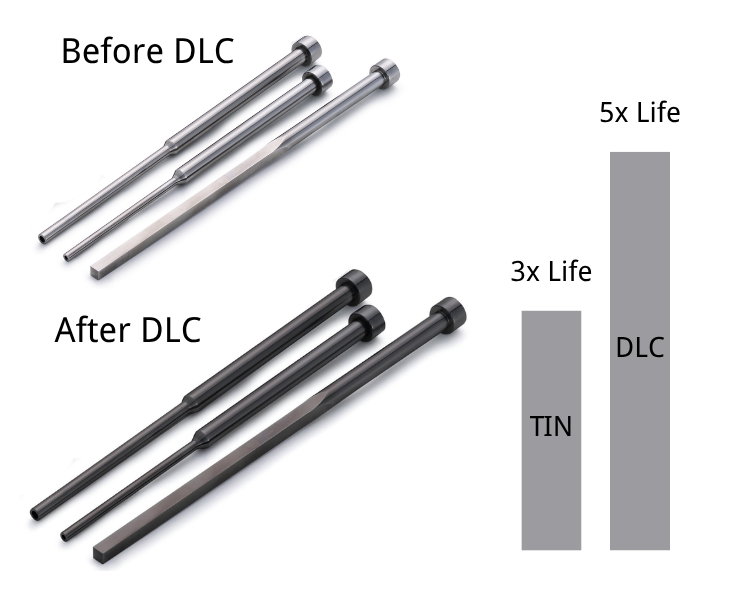
- TiN / TiCN / DLC Coatings — Characterized by an extremely low coefficient of friction and exceptional wear resistance, making them the ideal choice for long-cycle, continuous production environments. It will be 3x life for TiN, and 5x life for DLC.
From the professional analysis of technical drawings to precision manufacturing, precise heat treatment, and advanced surface coating processes—HTX is dedicated to providing you with customized and OEM-based Shoulder Ejector Pins, offering a complete suite of precision guiding and load control solutions for your mold systems.
Precision Manufacturing for Custom Shoulder Ejector Pins.
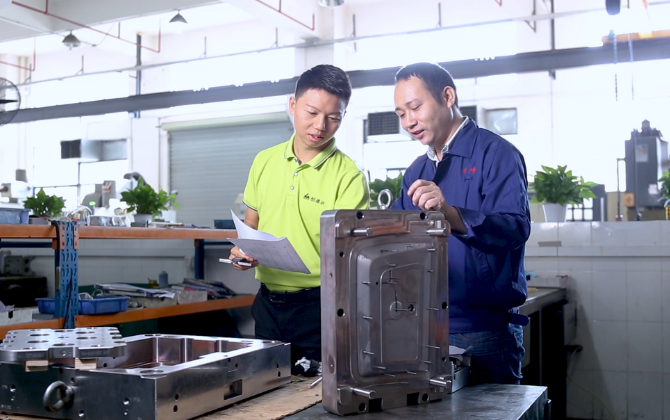
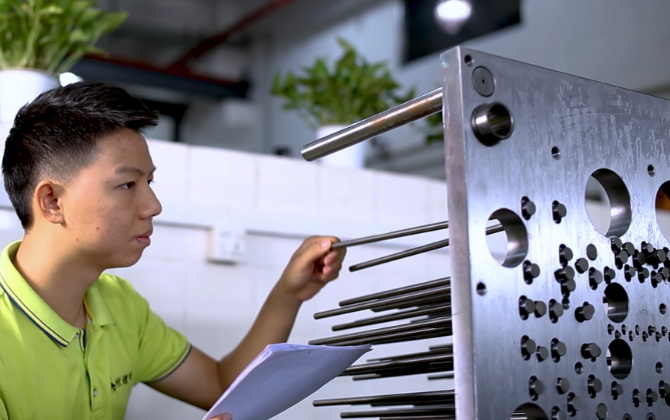
For custom-made shoulder ejector pins, stable concentricity and step precision are of far greater importance than mere standard machining. It covers the geometry of the shoulder, concentricity, hardness, and surface roughness—all of which are crucial for ensuring stable mould operation and extending service life. Our manufacturing process combines precision grinding, heat treatment, dimensional inspection, and dimensional inspection to ensure that every component meets the precise guidance and load requirements of your specific mould system in practical operation.
Customization Capabilities from HTX
HTX offers a selection of standard shoulder ejector pins, but our true strength lies in “geometric solutions”—optimized based on actual mold movement and load conditions, and wear environments within your mold system.
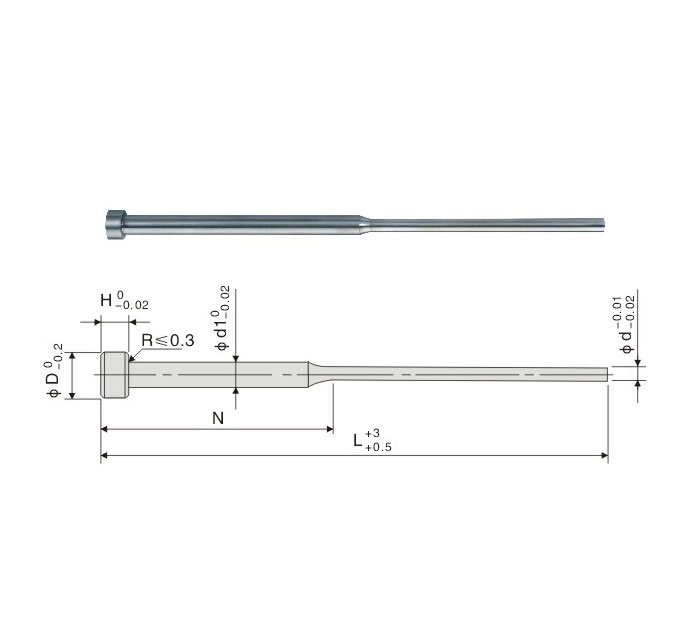
We offer 1:1 customization based on your drawings. Customizable parameters include: shoulder diameter, shoulder height, tip geometry, shank length, step transition radius, and concentricity (≤0.01 mm). As a critical geometric component, every dimension of the shoulder ejector pin directly affects positioning accuracy, guiding stability, and load transfer efficiency.
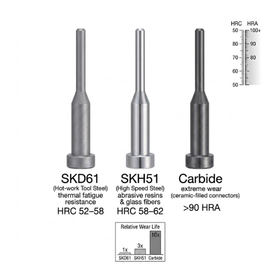
- H13 / SKD61 — Designed specifically for high-cycle molds, offering exceptional resistance to thermal fatigue.
- SKH51 (High-Speed Steel) — Designed specifically for materials containing abrasive resins or glass fibers, offering superior wear resistance.
- Carbide — Designed for extreme wear environments (e.g., injection molding of connector products containing ceramic fillers).
Engineering Parameters for Custom Shoulder Ejector Pins
- Material Selection for Shoulder Ejector Pins
- Common Shoulder Ejector Pin Problems & Solutions
- Precision Tolerance Control for Shoulder Ejector Pins
The material selection of shoulder ejector pins depends on mold cycle frequency, resin abrasiveness, operating temperature, and required service life. HTX provides different material options to balance wear resistance, toughness, and dimensional stability.
| Material | Hardness | Main Advantages | Recommended Applications | Wear Resistance | Toughness |
| SKD61 / H13 | HRC 52-58 | Excellent toughness and thermal fatigue resistance | General injection molds, high-cycle production | Medium-High | Excellent |
| SKH51 / M2 | HRC 58-62 | Higher wear resistance than H13 | Glass-filled resins, abrasive plastics, long-running molds | High | Medium |
| Carbide (WC+Co) | >90 HRA | Extreme hardness and wear resistance | Ultra-high wear applications, micro precision pins | Very High | Low |
| Failure Mode | Possible Cause | HTX Engineering Solution |
| Ejector Pin Bending | Excessive lateral load, insufficient guiding support, or improper mold alignment | Customized shoulder geometry improves load distribution; optimized fit clearance reduces lateral movement during ejection |
| Premature Wear | Insufficient surface hardness, unsuitable material selection, or abrasive resin conditions | Selection of SKH51/SKD61 based on application requirements; optional nitriding treatment (surface hardness up to HV800) improves wear resistance |
| Misalignment | Incorrect fit tolerance between ejector pin and mold plate, or insufficient concentricity control | Precision grinding process; concentricity control ≤0.01 mm ensures stable linear movement |
| Scuffing / Galling | Excessive friction, insufficient lubrication, improper clearance, or unsuitable surface treatment | Vacuum heat treatment combined with nitriding or DLC coating; optimized radial clearance 0.008–0.02 mm reduces friction and surface damage |
| Shoulder Fracture | Sharp shoulder transition, excessive impact load, or improper geometry design | Optimized shoulder transition with rounded fillet design improves stress distribution and reduces fracture risk |
Accurate fit between the ejector pin shaft and mold plate is critical for preventing excessive movement, friction, and premature wear. HTX controls shaft diameter tolerance, radial clearance, and concentricity according to mold requirements to ensure stable linear motion during repeated ejection cycles.
| Shaft diameter (mm) | Recommended shaft tolerance (h6/h7) | Radial clearance (mm) |
| 1.0 – 3.0 | h6 (-0 / -0.008) | 0.008 – 0.015 |
| 3.0 – 6.0 | h6 (-0 / -0.012) | 0.010 – 0.020 |
| 6.0 – 12.0 | h7 (-0 / -0.018) | 0.015 – 0.025 |
| >12.0 | h7 (-0 / -0.022) | 0.020 – 0.030 |
Additional Precision Parameters
| Parameter | HTX Capability |
| Concentricity | ≤0.01 mm |
| Surface roughness | Ra ≤0.4 μm |
| Shoulder geometry tolerance | Customized according to drawing |
The function of a standard ejector pin is solely to push the workpiece out; it is responsible only for axial thrust. A shoulder ejector pin, on the other hand, maintains controlled axial movement during the ejection cycle—it serves to limit travel and provide guidance, while simultaneously absorbing lateral loads. Standard ejector pins primarily provide ejection thrust; the shoulder ejector pins not only enhance guidance stability but also reduce lateral loads during the ejection process.
Yes, provided that the stepped structure is designed appropriately. In applications where the length-to-diameter ratio exceeds 8, or in scenarios involving eccentric ejection, stepped ejector pins can reduce the risk of bending by over 70% compared to straight-body pins; the stepped structure effectively distributes both the guiding forces and the ejection forces.
For standard custom dimensions (common diameters, SKD61/SKH51 materials, h6 tolerance), the MOQ is as low as 10–20 pieces. For highly specialized designs (unique shoulder geometries, carbide materials, or special coatings), the MOQ starts at 50 pieces. Additionally, we accept sample orders—the cost of samples can be credited toward your subsequent bulk production orders.
They are the same part—two names for one component. “Shoulder ejector pin” emphasizes the shoulder at the head for load-bearing and retention. “Step ejector pin” emphasizes the stepped diameter along the pin body for stroke control. The difference is only in naming, not in design or function.
- Standard Customization (SKD61 material, uncoated, batch size ≤ 200 units) → 10–15 business days.
- Expedited Orders (SKH51 material; nitrided or coated) → 7–10 days (subject to an expedited service fee).
- Extra-Large Batches (> 1000 units) or Special Materials (Carbide/Tungsten Steel) → 20–25 days.
HTX is equipped with fully-featured vacuum heat treatment furnaces and a precision CNC grinding workshop, allowing us to save 3–5 days on production scheduling. We are able to completely eliminate delivery delays often caused by outsourcing processing to external vendors.
- Standard Tolerances: Shaft outer diameter ±0.005 mm (h6), shaft shoulder thickness ±0.02 mm, and concentricity ≤0.02 mm.
- High-Precision Option: For micro-pins (diameter < 1 mm) or optical molds, we can achieve a diameter tolerance of ±0.002 mm and a concentricity of ≤0.005 mm.
All products undergo 100% inspection, and traceable inspection reports are available upon request.
This is because the cavity layout, guiding system, clearance tolerances, and ejection stroke vary uniquely for every mold. Standard shoulder ejector pins cannot accommodate these variables, which may result in inconsistent shoulder heights, poor concentricity, or even bending and breakage. Consequently, customization is not merely an option, but a necessary engineering requirement to ensure stable and reliable ejection performance.